Belgium
Looking forward - three things on the horizon for 2023:
- Whistleblowing. Companies with at least 50 employees should set-up internal reporting channels. Also, other companies should be mindful of the protection of whistle-blowers who use external channels to report.
- Training. Employers with at least 20 employees are obliged to develop annual training plans after prior consultation with the employee representative bodies (if any). The first plan must be established by 31 March 2023 at the latest.
- Social elections. Social elections are due in 2024 but the first steps in the procedure will commence in Q4 of 2023. Moreover, the thresholds for organising social elections are calculated based on the average staff numbers during 1 October 2022 to 30 September 2023.
Updates from Q4:
New rules on re-integration track (RIT) for sick employees. New rules have been introduced from 01 October 2022 as regards the re-integration process for employees who are unable to work, aimed at an effective re-integration by informing employees at an early stage about the possibilities of requesting (temporary) different or adapted work and/or adjustments to the workplace, allowing work resumption to take place in optimal conditions.
It should be noted that the termination of the employment contract due to medical force majeure will result in future ineligibility to the RIT process. Before, it was possible for an employer to invoke medical force majeure at the end of the RIT if the outcome of the RIT was that the employee was definitively incapable of performing the agreed function and no alternative function was possible. Under the new legislation, two separate procedures will apply, i.e. a procedure for the RIT and a procedure for an employer to invoke medical force majeure. The procedure for medical force majeure can only be initiated if no RIT is pending.
Non-compliance with the rules on health and safety at work may result in administrative sanctions up to €4,000 per employee involved. If the breach of the health and safety legislation results in health damage for the employee, a criminal sanction of €24,000 per employee involved could be imposed. Criminal sanctions are in theory possible but are rather exceptional. Moreover, a dismissal of a sick employee in breach of the RIT will result in the risk of that employee successfully claiming a discrimination indemnity equal to six months of salary.
For the key aspects of the new RIT please contact our Belgian team.
New permits for intra-corporate transfers. New types of work- and residence permits are being created in Belgium for intra-corporate transferees (legislation is not yet finalised) and will be applied if all conditions are met:
- the individual is a third-country national, residing outside the EU at the time of application;
- the individual must be a skilled manager, a specialist or a trainee (employee);
- the individual must be transferred (on secondment) to one (or several) undertakings of the company or group company within the EU to which their employer belongs;
- this transfer is for a maximum of three years for managers and specialists, and for a maximum of one year for trainees.
Once the individual is eligible, a few additional conditions have to be fulfilled depending on the region where the employee will work. The most common conditions are as follows:
- the individual must have a remuneration package which is at least as favourable as that offered in Belgium to workers in comparable positions in accordance with the applicable laws, collective agreements and practices;
- the individual must comply with a cooling-off period, whereby an interval of three months must elapse before submitting a new application for an EU ICT Permit for the same employee in Belgium;
- the individual must have their main residence outside the EU when applying for the EU ICT Permit.
In the case of an envisaged temporarily engagement of third-country nationals in Belgium (or in the European Union in general), application for the EU ICT Permit should be considered.
Draft bill on diverse employment relations. On 29 September 2022, the draft bill on diverse employment relations was approved providing more flexibility in the labour market aimed at achieving an 80% workforce participation rate by 2030. Read our Insight into the most important changes which may have an impact on employers here.
England
Looking forward - three things on the horizon for 2023:
- Whistleblowing - we expect to see a continued rise in whistleblowing claims in 2023. In an evolving workplace, increasingly populated by Millennials and Generation Z, we anticipate seeing a broader range of social and environmental issues being raised as protected disclosures. Whistleblowing law is designed to protect workers who raise concerns that “the environment has been, is being, or is likely to be damaged” (PIDA 1998) and this may be a focus area for 2023.
- Disability discrimination & long-Covid - Given that the Employment Tribunals are still facing a significant backlog, we expect to continue to see an increase in Covid-19 related cases into 2023. Aside from the outstanding Court of Appeal decision in Rodgers v Leeds Laser Cutting Ltd, it is likely that we will also see more cases in relation to health & safety breaches, mandatory return to the office and long-Covid constituting a disability for the purposes of disability and/or failure to make reasonable adjustment claims.
- Retained EU Law (Revocation and Reform) Bill - the progress of the Retained EU Law (Revocation and Reform) Bill (the “EU Law Bill”) is one to watch for 2023. The EU Law Bill provides for all unprotected EU-derived secondary legislation which has not been separately incorporated into national law to expire on 31 December 2023. This includes the right to 20 days’ annual leave, family friendly rights, protections from dismissal where employment is transferred or outsourced, maternity, pregnancy, part-time and fixed term worker protections and certain health and safety requirements. The Bill has been widely criticised, and there have been calls for it to be withdrawn, but the shape it ultimately takes will have a significant bearing on the shape and form of employment law protection in the UK in the future.
Updates from Q4:
Read our Employment Law Alert affecting employers in the UK over recent months.
France
Looking forward - three things on the horizon for 2023:
- Whistleblowing – implementation of the law of 21 March 2022 and Decree of 3 October 2022. Companies should be mindful to implement a policy in relation to whistleblowing or to adapt their internal company policies to ensure they are compliant with new requirements. Also, we are seeing a trend of employees claiming (mostly in the context of termination) that they are a whistle-blower in order to benefit from the associated protection on termination.
- Development of data subject access requests (DSAR) and associated difficulties for employers. Although the GDPR dates back from 2018, French employees have only recently starting using the possibility, provided under Article 15, to access the personal data of a data subject. As for whistleblowing, we are seeing a trend developing in this respect, mostly in the context of employee terminations, and such requests are quite cumbersome to manage for companies given the number of documents and emails this may involve. It is good to seek legal advice as to the strategy to implement to reduce this number and to best handle the DSAR response.
- Pension reform. The pension reform project will be officially presented on 15 December 2022. Possible increases to the legal retirement age (currently 62 years) could be to 65 years in 2031, or to 64 years but lengthening the contribution period.
Updates from Q4:
Profit-sharing. From 16 August 2022, a new law came into force providing emergency measures to protect purchasing power by implementing several new dispositions regarding profit-sharing. The new law:
- Increases the maximum duration of the profit-sharing scheme called “intéressement” (from 3 to 5 years)
- Enables employers to tacitly renew the “intéressement” multiple times in the agreement (this was possible only once before)
- In certain circumstances, it allows companies with less than 50 employees to implement “intéressement” by unilateral decision of the employer (previously this was only possible for companies with fewer than 11 employees
- Considers paternity leave as time worked for the calculation of the “intéressement”, and
- Implements temporarily (until 31 December 2022) an additional early release (in order to purchase goods/a house or the provision of services) of “intéressement” and “participation” rights that were invested in a company savings scheme (“PEE”) before January 2022.
Also, employers can distribute a new value-sharing bonus (former “Macron bonus” capped at €1,000/€2,000 which was payable until March 2022).
This new bonus is exempt from social security contributions and, temporarily, from CSG/CRDS and income tax, up to a limit of €3,000 (€6,000 in some cases) per beneficiary and per calendar year.
It is possible to pay this bonus in several instalments during the calendar year, but not more than once per quarter. A monthly payment is therefore prohibited.
Employers should consider informing employees about the possibility of benefiting from the early release of rights saved on the company savings scheme (point 5 above).
Buying back RTT days. Employees may request the “buy back” of their unused RTT days acquired from 01 January 2022 to 31 December 2025, subject to the agreement of their employer.
Only the following are eligible:- Employees subject to an hourly work week and working more than 35 hours per week, and
- Employees who have additional rest days as part of an arrangement on working hours over a period longer than a week,
This therefore excludes employees who are subject to a working time in days over the year (“forfait jours”) who can already give up their rest days.
Days or half-days that are bought back by the employer are paid at the rate of the first hour of overtime defined in the company, i.e., the hourly wage plus a minimum of 10% or 25% in the absence of a collective agreement.
This buy-back benefits from a favourable social and tax treatment up to €7,500.
Germany
Looking forward - three things on the horizon for 2023:
- Whistleblower Protection Act (Hinweisgeberschutzgesetz). Finally expected to come into force in Q1 2023. Please see our feature on this transposition of the Directive here.
- Working Hours Act Reform. In Q1 2023, the German Ministry of Labour is expected to provide guidelines for employers on the prerequisites for recording working hours. It remains to be seen if there will be the long-awaited reform and update to the working hours act to adapt to the ECJ and German federal labour court jurisprudence on recording working hours.
- Restructurings and Reductions in Force. Due to the general economic environment, we expect a further uptick in the need to implement restructurings and Reductions in Force. Our three-part Insight series examines the important role of German labour law in restructuring, looks into complex legal questions and problems that may rise and focusses on issues employers regularly face in connection with a planned staff reduction.
Updates from Q4:
Obligatory working time recording: rationale published. We outline the recently published and much-discussed decision of the Federal Labour Court which has provided clarity in essential aspects of the implementation of the recording of working hours, the obligations for employers, systems to be used, exclusion and what employers need to be doing now.
Minimum wage. The minimum wage rose to €12 per hour on 01 October 2022. A breach of the minimum wage can result in fines of up to €500,000.
Mini-Jobs. From 01 October 2022, the earnings limit for a so-called mini-job will be raised to €520 per month. In this case, employees are exempt from compulsory social insurance.
Hong Kong
Looking forward - three things on the horizon for 2023:
- Mandatory reference checks. The HKMA’s new employee reference regime for banks comes into effect in May 2023, intended to address the problem of “rolling bad apples”.
- Gig economy workers. The Government is expected to consider the introduction of employment rights and protections for workers in the gig economy.
- Designated savings accounts. The Government is expected to consider the introduction of a Designated Savings Account Scheme, whereby employers would be required to deposit funds to meet their future severance payment or long service payment liabilities, to come into effect following the abolition of the offset against mandatory provident fund contributions.
Update from Q4:
Fund Manager Code of Conduct (asset managers). In August 2022, amendments to the Fund Manager Code of Conduct (FMCC) came into effect. Fund managers of collective investment schemes (CIS) are now required to consider climate-related risks in their governance, investment and risk management processes, and make appropriate disclosures. ‘Large Fund Managers’ must comply with certain baseline requirements from August 2022, and an additional set of enhanced standards from November 2022. Other fund managers must comply with baseline requirements from November 2022.
The Securities and Futures Commission (SFC), Hong Kong’s financial regulator, is one of the first in the region to adopt such mandatory approach for fund managers. These new regulatory requirements make reference to the widely-endorsed Task Force on Climate-Related Financial Disclosures recommendations, aligning Hong Kong with international standards and global regulatory trends.
Whilst the SFC’s effort to promote ESG leadership in Hong Kong is welcomed by the industry, fund managers are generally concerned about the limited availability of data and lack of common standards to effectively meet disclosure obligations. As this first phase of the new regulatory requirements comes into effect, with quantitative disclosures for Large Fund Managers expected in mid-2023, we will be watching this space closely to see how the SFC’s compliance landscape and enforcement efforts will roll out.
Italy
Looking forward - three things on the horizon for 2023:
- Minimum-wage. Italy will need to transpose the EU directive n.2041/20422 on minimum wage by November 2024. The directive obliges EU countries to review local laws on this matter including for Italy updating the amount of minimum-wage provided in the national collective agreements
- Remote working. There has been an extension of current simplified remote working arrangements for vulnerable workers and parents with children under 14 during 2023.
- New hires. Employers who hire employees under 36 and women over 50 unemployed for more than 12 months on a permanent or fixed-term basis will receive a 100% social contribution exemption.
Updates from Q4:
EU Whistleblowing Directive: The Italian Parliament has recently approved a Legislative Decree to transpose the EU Whistleblowing Directive. We await publication once it has come into force.
The European Commission started an infringement procedure against 15 European countries including Italy for failure to transpose the EU Whistleblowing Directive in time, there is a possibility this could could be filed.
EU Directive on Transparent and Predictable Working Conditions. The EU Directive amends the Legislative Decree 152/1997. From 01 August 2022, the Italian legislator introduced new stricter requirements for the content and form of employment contracts (reference to the general provisions included in the National Collective Agreement no longer be sufficient).
Mandatory paternity leave. The National Security Authority (INPS) issued guidelines on paternity leave. Fathers are entitled to 10 days' mandatory, fully-paid paternity leave, funded by INPS, which can be taken consecutively or not (however it must be taken in separate days not hours). Paternity leave may be taken between the two months prior and up to five months after expected birth. In the event of multiple babies, the duration of paternity leave is 20 days. Fathers may take their mandatory paternity leave whilst the mother is on maternity leave. In order to use paternity leave, the employee must inform the Company in writing of the period he intends to benefit from the leave, providing at least five days' notice. Specific regulations will apply for adoption.
Netherlands
Looking forward - three things on the horizon for 2023:
- Taxation for foreign employees. The 30% ruling, allowing foreign employees to pay less tax over part of their salary, will be limited to a certain maximum amount corresponding to the so-called ‘Balkenendenorm’, which is the statutory maximum annual salary for top managers. In 2023, this amount will be set at €223,000 on an annual basis. The new ruling will take effect as per 01 January 2024. There will be a transitional arrangement for employees that joined a company before that date.
- Fixed term contracts. The government plans to revise the regulations for fixed term contracts. One of the current proposals is to replace on-call contracts (zero hours contracts) with “basic contracts” which will amongst others include a standard amount of working hours. In addition, the government proposes to remove the possibility to include a six-month break between two fixed term contracts, in order to prevent the chain of three fixed term contracts to start over again. After three fixed term contracts, the fourth contract automatically turns into an indefinite contract.
- Non-taxed allowance increases. As of 01 January 2023, the amount of untaxed travel allowance will increase to €0.21 per kilometre. The untaxed working from home allowance will be increased to €2.13 per day.
Updates from Q4:
‘Working where you want’ Bill. A bill to amend the Dutch Flexible Working Act (Wet flexibel werken) has been approved by the Lower House of Parliament. The Flexible Working Act deals with balancing work and family life. The current Act regulates the rights of the employee with respect to working hours, working time and working place. The bill called ´Working where you want´ was submitted aiming to change the distinction between the employee’s right to adapt the workplace and the right to adapt the working hours or working time.
If an employee wishes to change their work location, a request can be submitted to the employer, provided that the employee has been employed by the relevant employer for six months (or longer).
Following submission of the request, the employer is obliged to enter into consultation with the employee. The employer must weigh up all interests and may only reject the request if its interests in all reasonableness and fairness outweigh the interests of the employee in an adjustment to the workplace. Only when the requested work location is a location that is not the employee's home address or the employer's work location (e.g. a holiday home) can the request still be rejected without prior consideration of interests. This also applies in case the employee requests a work location outside the EU.
As the bill will still need to be approved by the Senate, the date the act will enter into force is unclear.
EU Directive on Whistleblowers. The House for Whistleblowers Act will be renamed the Whistleblower Protection Act. This Bill is currently progressing through legislative procedure.
The legislative proposal includes (amongst others) the following key changes:
In our view, the most important and far-reaching change is that reporters will be given the opportunity to report directly externally (outside their own organisation).
The Bill shifts the burden of proof: The employer will have to prove that the disadvantage suffered by the reporter is unrelated to the report.
The Bill also provides for several protection and support measures in order to protect the reporting persons against retaliation such as dismissal, suspension, transfer, or harassment.
The Act currently only provides protection for (former) employees and public servants. This protection will be extended to the broader circle of natural persons as referred to in the Directive (e.g. self-employed persons, shareholders, board members, facilitators, interns, or even third parties closely associated with a reporter such as colleagues or family members). In the explanatory memorandum to the legislative proposal, it is specified that this also includes confidential advisors and trade union representatives.
The implementation deadline of 17 December 2021 was missed. The European Commission had to decide ultimately by mid-November 2022 whether or not to initiate an infringement procedure at the European Court. As these proceedings are confidential, it has not been made public whether or not any proceedings were initiated.
In light of the above, the Minister of the Interior and Kingdom Relations is aiming for the Bill to be approved by the House of Representatives as soon as possible.
PRC
Looking forward - three things on the horizon for 2023:
- Covid-19. The Chinese government is gradually softening the control measures of the covid-19 pandemic, which may revitalize the economy and improve employment relations.
- Sexual harassment. With the implementation of the amended Law on the Protection of the Rights and Interests of Women, protection for female employees against sexual harassment in the workplace will be strengthened, see below.
- Parental rights. As the central government takes a series of measures to encourage population growth, the local government may stipulate more details on the benefits available to parents.
Updates from Q4:
New Provisions on Sexual harassment. On 30 October 2022, the Standing Committee of the National People’s Congress passed the amended Law on the Protection of the Rights and Interests of Women (the “Amended Women’s Protection Law”), which will come into effect on 01 January 2023. While touching on a wide range of topics, the Amended Women’s Protection Law gives special focus to preventing and controlling sexual harassment.
- Sexual harassment conducted against women in the form of verbal abuse, texts, images, physical contact, etc. is prohibited.
This clarifies that the form of sexual harassment is not limited to inappropriate physical contact, but also includes inappropriate language and jokes toward females, which lowers the bar for recognising the existence of sexual harassment. - The Amended Women’s Protection Law requires employers to take various measures to prevent and control sexual harassment against women, such as:
- Establish regimes on prohibiting sexual harassment;
- Designate responsible departments or persons;
- Carry out education and training programs on preventing and controlling sexual harassment;
- Take necessary security measures;
- Set up channels for complaint;
- Resolve the conflict in a timely manner and protect the privacy and personal information of the persons involved by building and improving the investigation and settlement procedures; and
- Support and assist the victims in defending their lawful rights, and provide counselling for them when necessary.
- If employers fail to perform their responsibilities on preventing and controlling sexual harassment, they may be required by regulators or competent authorities to rectify their practices and the responsible persons may be punished.
- Sexual harassment conducted against women in the form of verbal abuse, texts, images, physical contact, etc. is prohibited.
New Provisions of Shanghai on Parental Leave. On 10 November 2022, following the Regulation of Shanghai Municipality on Population and Family Planning (amended in 2021), the Shanghai government released the Provisions of Municipality of Shanghai on Rewards and Subsidies for Family Planning (the “Provisions”). The Provisions further address the leave entitlements, rewards and subsidies relating to family planning policy.
Among others, the Provisions provides more guidance on childcare leave. Both female and male employees are entitled to five days of childcare leave each year before their child reaches the age of three. Childcare leave days are calculated according to the number of children the employee has. Salary during childcare leave shall be paid in accordance with normal salary, used in the current year and taken over consecutive or separate days.
Singapore
Looking forward – three things on the horizon for 2023:
- Overseas Networks & Expertise Pass / New point system for applications. From 1 January 2023, a 5-year personalised work pass will be introduced allowing the holder to concurrently start, operate and work for multiple companies at one time. Employers also should note that from 1 September 2023, for new employment pass applications to qualify, a COMPASS point-based system must be passed in addition to the current qualifying salary requirements.
- Workplace anti-discrimination laws. The possibility of formally enshrining into law the Tripartite Alliance for Fair & Progressive Employment Practices (TAFEP) guidelines.
- Mandatory reference checks. The possible introduction of these by the Monetary Authority of Singapore for representatives of financial institutions.
Updates from Q4:
Strengthening protection for Platform Workers. The Singapore government has accepted all 12 recommendations made by the Advisory Committee on Platform Workers. Under these recommendations, Platform Workers (i.e. delivery workers, private-hire car drivers and taxi drivers who use online platforms to match them with demand for their delivery and point-to-point transport services) can look forward to:
(a) Greater financial protection in cases of work injury: Platform Workers are to be covered with the same scope and level of work injury compensation as under the Work Injury Compensation Act.
(b) Improved housing and retirement adequacy: Central Provident Fund (CPF) contribution regime to be mandatory for Platform Workers below the age of 30, and optional for those aged 30 and above.
(c) Enhanced representation: A new Tripartite Workgroup on Representation for Platform Workers will be set up to co-create a new formal representation framework for Platform Workers.The Singapore government intends to implement the recommendations in a progressive manner from the later part of 2024. This will include amendments to legislation (as opposed to only the introduction of guidelines) and will provide greater certainty for Platform Workers and assist to safeguard their interests.
Spain
Looking forward - three things on the horizon for 2023:
- Digital nomads. Increase of "digital nomads" as a consequence of the latest tax reform in relation to foreign remote workers (see below).
- Labour law. Strong campaigns by the Labour Inspectorate on working time and overtime monitoring, also equal pay and the execution of equal gender plans.
- Restructuring consultation. Increased consultation processes planned for restructuring and/or to modify working conditions.
Updates from Q4:
New equal treatment and non-discrimination law. On 13 July 2022, the new Law 15/2022, Integral for equal treatment and non-discrimination came into force. Although this new law includes rights and protections already covered by Spanish law, there are various new regulatory aspects employers need to be aware of.
Further to the broad protection offered under Spanish legal system and case law, the new regulations offer new protections which include:
- A much broader concept of illness as a cause of discrimination.
- Prohibits employers asking about health conditions during recruitment.
- Application of sufficient methods for detection of discriminatory situations and the adoption of preventative measures.
- Definition of discriminatory harassment (including other definitions such as the concept of reprisals, discrimination by association or mistake as well as multiple and intersectional discrimination).
- Effective judicial protection requiring judges and courts of adopt all necessary measures for immediate cessation of discrimination, prevention of imminent violations and compensation of damages or reinstatement.
- Legitimises trade unions to be part of judicial proceedings.
- Reversal of burden of proof whenever Claimant or interested party provides well-founded indication of discrimination.
- Employers to be responsible for repairing damage in employment related discrimination.
- Employer and employee representatives, through collective bargaining, to ensure compliance with the right to equal treatment and non-discrimination and positive action measures.
- The employer may undertake social responsibility actions aimed at promoting conditions of equal treatment.
Failure to comply may give rise to administrative, criminal and civil liability.
Minor infringements will carry fines of between €300 and €10,000.
Serious infringements will carry fines between €10,001 and €40,000.
Very serious infringements will carry fines between €40,001 and €500,000, plus the imposition of accessory penalties, such as the withdrawal, cancellation or total or partial suspension of official aid.
Spain plans “digital nomad” visa scheme for remote workers. The expatriate tax regime (also known as the Beckham Law) offers favourable tax treatment to non-residents who move to a Spanish territory to take up employment. It allows such persons to continue to pay taxes as a non-resident in Spain in the year when they move to Spain and in the following five years, resulting in reduced tax rates on Spanish-source income.
The amendments introduced into the Spanish expatriate tax regime provide a more flexible framework for a wider range of persons considering a move to Spain to qualify for the regime. Of particular relevance are those creating a more flexible framework for remote workers (including digital nomads) and directors, as well as those provisions allowing the extension of the regime to other family members, circumstances which had prevented a number of relocations in the past. The reduction of the 10 years term to 5 years of previous non-Spanish tax residence is also welcome.
UAE / DIFC
Looking forward - three things on the horizon for 2023:
- New UAE Federal Labour Law. UAE companies (excluding those within the DIFC or ADGM free zones), must comply with the new UAE Federal Labour Law by February 2023. In particular, this involves amending employment contracts from unlimited term to fixed term.
- UAE Data Protection. Watch out for the implementation regulations for the UAE data protection law which we except to be published at some point next year. Employers throughout the UAE (excluding the DIFC and ADGM which have their own data protection laws) will need to comply with these regulations when they are released.
- Emiratisation Targets. UAE employers (employers outside the UAE free zones) must comply with the targets from 1 January 2023 or face significant fines.
Updates from Q4:
New UAE Unemployment Insurance
From 1 January 2023, employees of UAE companies will be required to register and make payments to the UAE Unemployment Insurance Scheme (the “Scheme”). If an employee fails to register and pay the monthly fees for the Scheme, then fines will be applied. The purpose of the Scheme is to provide the insured employee with income for a period during unemployment. We understand that, at least initially, the scheme will not apply to employees of DIFC or ADGM companies.
There are two categories of employees:
(a) Employees in the “first category” and earning a basic salary of AED 16,000 per month or under will need to pay AED 5 (plus VAT) per month and their monthly compensation is capped to a maximum of AED 10,000; and
(b) Employees in the “second category” and earning a basic salary exceeding AED 16,000 AED 20,000 will need to pay AED 10 (plus VAT) per month and their monthly compensation is capped to a maximum of AED 20,000.Provided an employee has been insured for at least 12 months, subject to the caps referenced above, they will receive the compensation of up to 60% of their basic salary for a period of up to three months following termination of employment. The compensation is payable for three months following termination of employment or the date the employee obtains new employment, whichever is sooner. The compensation will not be payable if the employee has been dismissed for a gross misconduct reason and the scheme is designed to apply to redundancy type terminations of employment.
The requirements with respect to registration, payment of the monthly subscription fee and the risk of fines applies to the employee (not the employer). However, in terms of best practice, we recommend that UAE employers inform their employees of the requirements to register and how to go about this so that employees can comply by January 2023. Please contact David McDonald or Tara Jamieson if you need any assistance with creating appropriate employee communications.
Emiratisation targets for the UAE private sector (excluding free zones)
The UAE government aims to meet targets of 75,000 Emirati citizens working in the private sector by 2025 and ambitious targets have been set for employers. Failure to meet these targets requires employers to pay substantial fines for each month of non-compliance. Private sector companies with 50 or more employees are required to increase their Emirati workforce by 2% per year until they reach 10% in 2026. These new requirements will place significant pressure on many UAE employers to attract and retain Emirati talent. The requirements do not apply to employers set up in UAE free zones.
From 1 January 2023, there are new quotas as follows for employers:
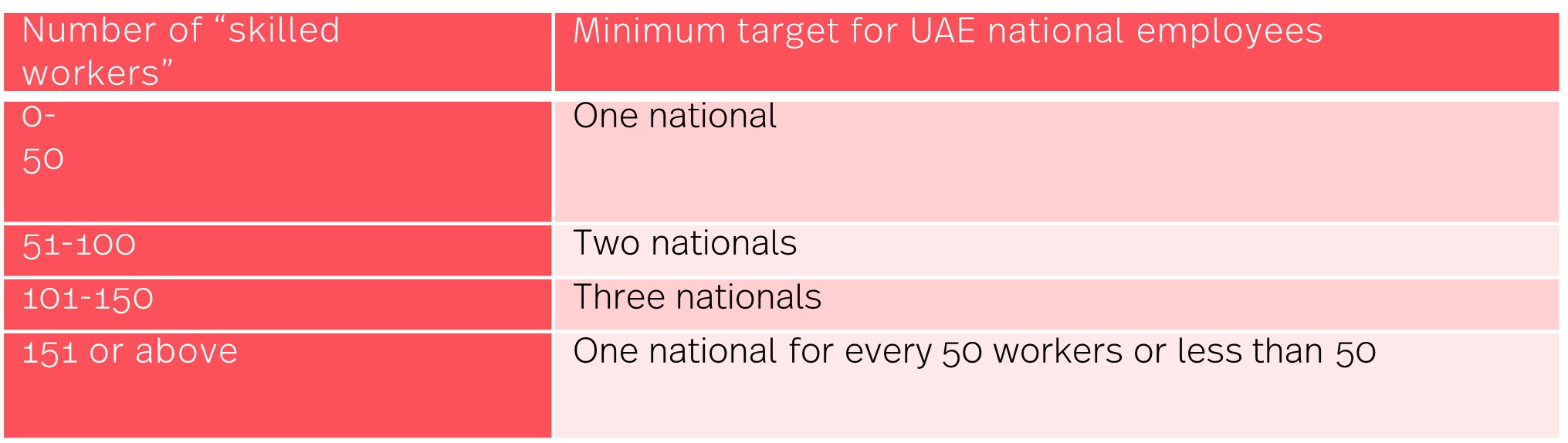
For employers in the banking or insurance sectors the quotas remain at 4% and 5% respectively. There also incentives to companies which substantially exceed these Emiratisation targets.
The fines for non-compliance with the quotas are AED 6,000 per month per Emirati employee short of the quota. This fine is increased by AED 1,000 per month per year for non-compliance.
We can advise UAE employers on the requirements and also which types of employees meet the definition of “skilled workers”. Please contact David McDonald or Tara Jamieson for more information.