Germany: labour law in restructurings (part 2)
In part 2 we look at topics such as reconciliation of interests, social compensation plans, terminations for operational reasons and mass redundancies.
In the first part of our Insights on labour law in restructuring, we have already provided information on the term of restructuring, the entrepreneurial decision and the basics of co-determination in operational changes. In this second part of the Insight, the topics of reconciliation of interests and social compensation plans, terminations for operational reasons and mass redundancies are dealt with in more detail. Here, too, complex legal questions and problems arise that employers should keep in mind during any restructuring.
Strengthened through the crisis
"Restructuring" is more present than ever in times of the Corona pandemic. For more than a year now, many companies have been struggling with unforeseen economic difficulties. Short-term reactions, such as short-time work or receiving financial support by the government, have not been able to prevent companies in many sectors from getting into a critical (financial) situation. Many companies are therefore confronted with the question of what design options are available to pave a strengthened way out of the crisis. One possible solution is restructuring, with the help of which a company can be reorganised and optimised in order to remain economically successful on the market in the future and to be prepared for future challenges.
Reconciliation of interests
If, on the occasion of a restructuring, an operational change within the meaning of Clause 111 of the German Works Constitution Act (Betriebsverfassungsgesetz, "BetrVG") is carried out and a works council has been established, the employer must at least attempt to reach an agreement with the works council on a so-called reconciliation of interests (Interessenausgleich, cf. Clause 112 (1) BetrVG) before implementing the planned change of operation. Within the framework of the reconciliation of interests, it is intended to determine the whether, how and when of the operational change.
The content of a reconciliation of interests describes in detail the planned operational change and in particular its effects on the employees (eg the date of an intended plant closure, the number of employees to be terminated or regulations on retraining and further training programmes). The content of the reconciliation of interests is not conclusive and depends on the individual negotiations between the parties for each operational change.
A reconciliation of interests can be combined with a so-called list of names (Namensliste). Employees who are mentioned in this list of names as intended for termination can be more easily terminated by the employer. The reconciliation of interests with a list of names presumes that the termination is required due to "urgent operational needs" (Clause 1 (2) of the German Protection Against Dismissals Act (Kündigungsschutzgesetz, "KSchG")). Thus, the employer no longer has to prove the cessation of the employment need for the terminated employee in an elaborate manner. Furthermore, the employee can only complain to a limited extent about the incorrectness of the social selection required in the context of a termination. When examining the social selection, only "serious mistakes" are to be taken into account (cf. Clause 1 (5) KSchG).
If the parties cannot agree on the content of the reconciliation of interests, they can request the executive board of the Federal Employment Agency to mediate (Clause 112 (2) BetrVG). Usually, however, if no agreement is reached on a reconciliation of interests, the parties call on the conciliation board (Einigungsstelle). The conclusion of a reconciliation of interests between the parties is voluntary and cannot be forced by either side. A replacement of the reconciliation of interests by the decision of the conciliation board is - in contrast to the social plan - not provided for. If the employer finally rejects the reconciliation of interests, the conciliation board merely establishes the failure of the negotiations.
Social plan
If an employer intends to implement an operational change within the meaning of Clause 111 (1) BetrVG and a works council has been established, the employer must conclude a social plan with the works council. A social plan is an agreement on the compensation or mitigation of the economic disadvantages suffered by the employees as a result of the planned operational change (Clause 112 (1) 2 BetrVG). Pursuant to Clause 112 (1) 3 BetrVG, the social plan has the effect of a works agreement.
The objective of the social plan is to mitigate the foreseeable economic and other disadvantages for the employees of a company caused by the operational change. A complete compensation of disadvantages does not have to be achieved by the social plan, a mitigation is sufficient.
The employer and the works council also have a wide scope in designing the social plan. Regular components of social plans are, for example, severance payments in the event of termination for operational reasons, supplements to the employee's unemployment benefits, early retirement and old-age part-time work, voluntary programmes or the establishment of transfer companies.
Generally speaking, a social plan is concluded in a similar way to a reconciliation of interests. After the employer has fully informed the works council about the planned operational change, the parties negotiate the content of a necessary social plan. If both parties are unable to agree on a social plan, the conciliation board is called upon or, at the request of one of the parties, appointed by the courts. Further negotiations then take place before the conciliation board. Unlike the reconciliation of interests, however, the employer cannot end the procedure unilaterally by agreeing or rejecting the social plan. If no agreement is reached between the parties, the conciliation board makes a final decision on the content of the social plan, exercising its equitable discretion (Clause 76 (5) 3 BetrVG). The decision of the conciliation board replaces the agreement between the employer and the works council. This is the decisive difference to the reconciliation of interests.
Disregard for the rights of co-determination within the company
If the employer fails to seriously negotiate a reconciliation of interests on the occasion of an operational change, employees can initially assert a so-called claim for compensation for disadvantages (Nachteilsausgleichsanspruch) against the employer (Clause 113 BetrVG). The claim for compensation for disadvantages also exists if the employer deviates from a concluded reconciliation of interests without good cause. In the event of job loss or other economic disadvantages, employees can acquire a claim for compensation against the employer within the framework of the compensation for disadvantages, which is calculated according to Clause 10 KSchG.
In the event of significant disregard of co-determination rights on the part of the employer, the works council may, if necessary, also assert a claim for injunctive relief within the framework of a resolution procedure (Clause 23 (3) BetrVG). However, a considerable amount of time may pass before a court decision on the injunctive relief is available in such resolution proceedings.
In practice, the question therefore often arises whether the works council can also assert its (alleged) claim for injunctive relief in urgent proceedings. Whether the works council can prevent the employer from implementing the operational change by way of an interim injunction is, however, not decided uniformly by the 18 German Regional Labour Courts (Landesarbeitsgerichte, "LAG"), so that the chances of success of the urgent proceedings depend in particular on the location of the establishment and the local competent labour court. The Federal Labour Court cannot provide clarity on this issue, as only two instances are open in interim injunction proceedings.
The current situation is as follows (subject to changes in case law):
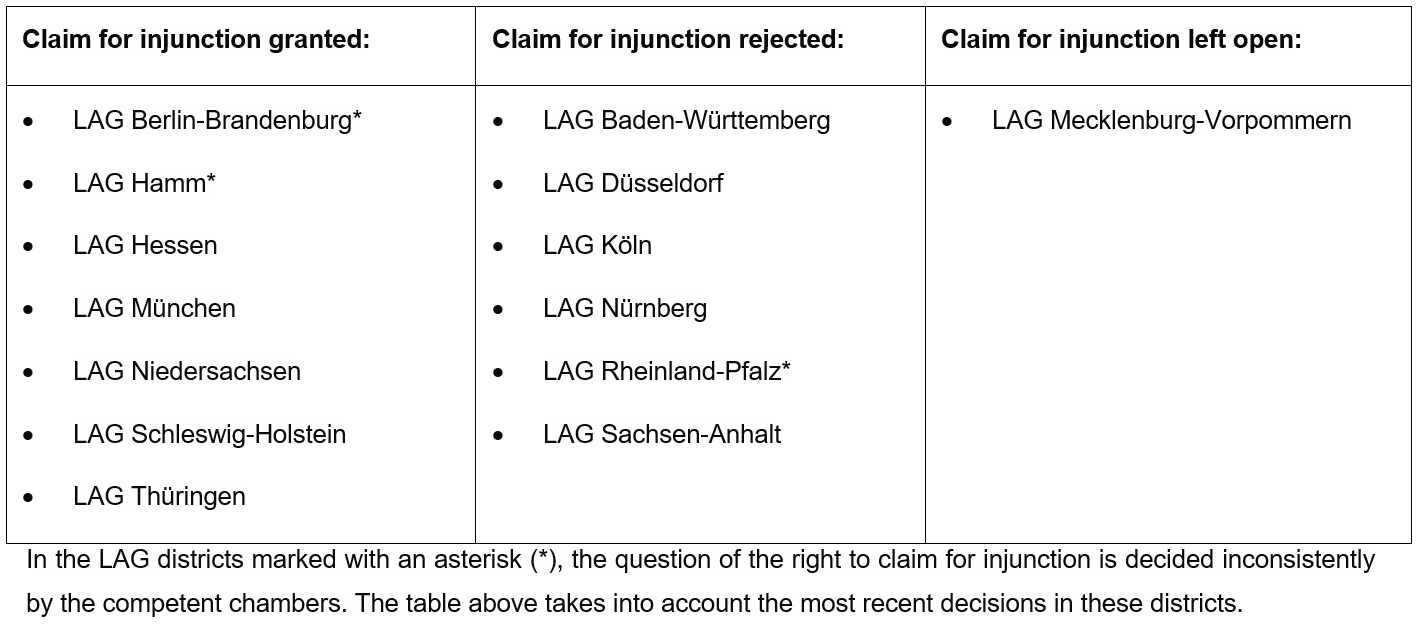
In favour of the existence of a right to an injunction, it is argued that the works council's participation rights under Clause 111 BetrVG are intended to ensure that the interests of the employees are taken into account in the decision of the employer and that the works council must therefore have a possibility of preventing the employer's conduct in violation of co-determination in the event of a failure to consult. Since the claim for compensation for disadvantages under Clause 113 (3) BetrVG did not offer sufficient protection of the works council's rights, the granting of a claim for injunctive relief was necessary to achieve conduct in conformity with the works constitution.
The opposing view argues that the assumption of a claim for injunctive relief would run counter to the legal system. It would be contrary to the system if, according to Clause 113 BetrVG, the employer could effectively issue terminations in deviation from agreements in the reconciliation of interests, but these measures, which are legally permissible in an individual relationship, could be blocked by filing a claim for injunctive relief. In § 113 (3) BetrVG, the German legislature had provided for a sufficiently deterrent individual legal consequence for the non-observance of the works council's participation rights. There was no room for an independent right of the works council to take legal action by way of an interim injunction. In addition, the legislature, in structuring the participation procedure according to §§ 111 et seqq. BetrVG, the legislature intended to protect the employer's entrepreneurial right to make decisions. It was not compatible with this if the works council could block the realisation of the employer's project by means of an interim injunction.
Whether the works council can enforce its claim for injunctive relief in urgent proceedings and thus block the employer's implementation of the planned operational change must always be examined on a case-by-case basis and depends decisively on the LAG district in which the employer's business is located.
If the employer does not inform the works council completely and correctly about the operational change to be implemented, a fine of up to €10,000 may also be imposed on the employer under Clause 121 BetrVG.
Continued in part 3 of the series
The third part of our Insight series focuses on labour law issues regularly encountered by employers in connection with a planned staff reduction.















_11zon.jpg?crop=300,495&format=webply&auto=webp)
_11zon.jpg?crop=300,495&format=webply&auto=webp)
_11zon.jpg?crop=300,495&format=webply&auto=webp)