Belgium
Implementation of the EU Directive on Transparent and Predictable Working Conditions. The Council of Ministers has approved a preliminary draft bill that partially transposes the European Directive (EU) 2019/1152 on Transparent and Predictable Working Conditions in the European Union.
The proposal needs to be submitted to parliament, but some institutions still need to give their advice. Kindly note that these principles must still be implemented in legislation. This can have an important impact on the content and modalities of the new legal framework.
Although the Directive needs to be transposed by 2 August 2022, the planned date of entry into force is 1 November 2022. Please contact our Belgian team for further detail about the transposition of this Directive in Belgium.
International telework after COVID-19. Now that almost all COVID-19 measures cease to apply, questions remain about the status of international teleworkers. These are all employees who work remotely in their state of residence on behalf of their employer based in another member state. During the pandemic, these teleworkers enjoyed a so-called “no impact period” from a social security perspective. This period implied a force majeure situation, temporarily suspending the operation of the conflict rules for work patterns altered by the pandemic (such as increased telework).
Now, a transition period has been approved and will apply until 31 December 2022, for the designation of the competent Member State for the social security of teleworkers.
The transition period will have the same effect as the COVID-19 measures. As a result, there will be no change to the competent state due to telecommuting 25% or more in the state of residence. Again, no specific formalities are required by the employer or employee.
The Belgian National Social Security Office (NSSO) will apply this transition period to pre-existing and new telework activities alike.
It is, however, important to note that this transitional period only applies to social security, not to the Limosa declaration obligation.
The Limosa obligation was temporarily suspended due to the COVID-19 force majeure situation, but this ended on 30 June 2022, so therefore from 01 July 2022 a Limosa declaration must be made for those teleworking in Belgium in the service of a foreign employer. For example, in the case of hybrid work that is partly in Belgium and partly on the employer's premises, temporary "workation" status in Belgium will re-apply.
Recent case law for working time – exempt employees. The Belgian Supreme Court (“Hof van Cassatie” - “Cour de Cassation”) has in a recent decision made a significant clarification in relation to employees in a leading position or a position of trust.
Pursuant to the Belgian Labour Code of 1971, employees in a leading position or a position of trust are excluded from the legal provisions on working time. This implies that for such a function, an employer may not be able to meet the, often complex, requirements regarding working time, night work, rest, breaks, etc.. A royal decree of 1965 lists the various positions falling within the scope of leading positions or positions of trust. This list refers, among other positions, to persons who, under their responsibility, can bind the company to third parties.
The Supreme Court has decided that the power to bind the company to third parties does in itself not suffice to be considered as an employee holding a leading position or a position of trust. Only employees who can bind the company vis-à-vis third parties to commitments of a certain importance can be considered as occupying a leading position or a position of trust to which the rules on working time do not apply. Unfortunately, the Supreme Court does not specify which criteria to determine what should be understood by “commitments of a certain importance”. This means that in practice, a case-by-case analysis will still be required.
Miscellaneous new legislation in the pipeline:
- The Council of Ministers approved preliminary draft legislation amending several provisions in order to strengthen transparency in the framework of the occupational pensions plans. One of the main objectives is to create a level playing field in relation to the transparency requirements between pension funds and insurance companies that are managing occupational pension plans
- As communicated in our previous update, the Belgium federal government agreed on a Labour Deal which contains a number of measures providing more flexibility at the labour market that aim at ensuring that Belgium achieves an 80% work force participation rate by 2030.
- As previously mentioned, the Belgian federal government has approved a draft bill to protect whistle-blowers.
England
Read our Employment Law Alert affecting employers in the UK over recent months.
France
EU Directive on Transparent and Predictable Working Conditions. The Directive 2019/1152 "on transparent and predictable working conditions in the European Union" entered into force in France on 01 August 2022. Employers must communicate to employees at the beginning of the working relationship more information than before. In addition a number of minimum requirements in terms of working conditions are strengthened, such as the limitation of the length of the trial period (up to 6 months for permanent contracts) or the prohibition in principle of exclusivity clauses (with possible exemptions). Please contact our French team for further detail about the transposition of this Directive in France.
Damages for unfair dismissal and related caps: A decision by the Supreme Court dated 11 May 2022, upheld the Macron sliding scale of damages (barème Macron) which limits the amount of damages an employee can claim for a dismissal without real and serious cause, depending on his/her seniority.
The decision has been criticised by employees' defenders for constituting a real "permission to dismiss". In practice this decision is good news for employers as it confirms the consistent position of the Supreme Court on this issue, but it also brings legal certainty and legal equality for all citizens.
The European Committee of Social Rights (ECSR), the supervisory body of the Council of Europe responsible for examining compliance with the European Social Charter by the States Parties, will render a decision by 26 September 2022 regarding the scaling of the barème Macron to conform with article 24 of the European Social Charter. However, since the Supreme Court reaffirmed that the European Social Charter has no direct effect in France, there is no reason for the Supreme Court to change its position. Nevertheless, the decision of the ECSR could fuel some resistance from trial judges but with no real chance of success.
Profit-sharing. A new law is in force from 16 August 2022 which provides emergency measures to protect purchasing power through changes to profit-sharing arrangements. The new law:
Increases the maximum duration of the profit-sharing scheme called “intéressement” (from 3 to 5 years)
Enables employers to tacitly renew the “intéressement” multiple times in the agreement (this was possible only once before)
In certain circumstances, it allows companies with less than 50 employees to implement “intéressement” by unilateral decision of the employer (previously this was only possible for companies with less than 11 employees
Considering paternity leave as time worked for the calculation of the “intéressement”, and
Implementing temporarily (until 31 December 2022) an additional early release (in order to purchase goods/a house or the provision of services) of “intéressement” and “participation” rights that were invested in a PEE before January 2022.
New value-sharing bonus (former Macron Bonus). From 01 July 2022, employers can distribute a new value-sharing bonus (former Macron bonus capped at €1,000/€2,000 that was payable until March 2022). This new bonus is exempt from social security contributions and, temporarily, from CSG/CRDS and income tax, up to a maximum of €3,000 (€6,000 in certain circumstances) per beneficiary and per calendar year. It is possible to pay this bonus in several instalments during the calendar year, but not more than once per quarter. A monthly payment is therefore prohibited.
Germany
EU Directive on Transparent and Predictable Working Conditions. The German transposition law entered into force on 1 August 2022. The transposition law has meant that various German laws have been adapted. The most important changes concern the German Evidence Act. Stricter regulations for employers regarding proof of "essential working conditions" apply from 1 August 2022 and in almost every case goes beyond what is the subject of standard employment contracts in Germany. Consequently, there is an urgent need for adaptation. Additionally, the "essential working conditions" must be in strict written form (wet-ink) – electronic documents/signatures are not sufficient. We explain the measures employers need to take to address the new measures from 1 August 2022.
EU Work-Life-Balance Directive. Although the EU Work-Life Balance Directive obliges its member states to introduce father’s leave of a minimum of ten days by 2 August 2022, Germany still does not provide such leave. The entitlement to ten days father’s leave has not been implemented in Germany. According to the German government, the German statutory provisions with regard to paternity leave are beneficial enough for fathers and go far beyond the requirements provided for within the EU Work-Life Balance Directive.
Please contact our German team for further detail about the transpositions of these Directives in Germany.
Hong Kong
Abolition of the offsetting of statutory severance and long service payments from MPF. On 17 June 2022, draft legislation was published to abolish the arrangement which allows an employer to offset statutory severance payments and statutory long service payments from an employer’s contributions to an employee’s mandatory provident fund (MPF). The changes are expected to take effect in 2025.
Dismissal of unvaccinated staff not “unreasonable”. On 17 June 2022, new legislation came into effect which confirms that dismissal of an employee due to failure to comply with an employer’s legitimate vaccination request will not be considered as an unreasonable dismissal. Following this change in the law, we anticipate that more employers in Hong Kong may introduce a mandatory requirement for staff to be vaccinated and dismiss staff who are unvaccinated, unless they are medically exempt, pregnant or breastfeeding.
Sex discrimination found by reason of pro-female bias. In Tan, Shaun Zhi Ming v Euromoney Institutional Investor (Jersey) Ltd [2022], the District Court found that an employer had discriminated against a male employee by reason of his gender by: (1) requesting the employee to apologise to a female colleague who had accused the employee of sexual harassment, albeit that the allegations were unsubstantiated, and (2) dismissing the employee after he refused to apologise. The Court found that the dismissal was influenced by a pro-female bias, and hence constituted sex discrimination. Had the employee been a woman, the employer would not have required her to offer an apology in response to an unsubstantiated allegation of sexual harassment, nor dismiss her after she had refused to apologise.
Italy
EU Directive on Transparent and Predictable Working Conditions. From 1 August 2022, the Italian legislator introduced new stricter requirements for the content and form of employment contracts (reference to the general provisions included in the National Collective Bargaining Agreement is no longer sufficient). The new legislation:
- applies to subordinate employment contracts and to independent contractors with the exclusion of agency agreements, consultancy and freelance agreements;
- requires employers to adapt template employment contracts for new joiners and to update the existing employment agreements respecting the deadlines provided for in the new legislation;
- provides for an administrative fine of €250 to €1,500 per each individual violation.
Please contact our Italian team for further detail about the transposition of this Directive in Italy.
Spotlight on whistleblowing. The Italian Parliament has recently approved the enabling law ("legge delega") for the transposition of European directives, including the European Directive on whistleblowing, providing the Government a three-months period to adopt a decree on the whistleblowing.
The Italian Data Protection Authority recently sanctioned an IT company which had provided whistleblowing services to a hospital for a GDPR violation. The software provided to the hospital by the IT company did not guarantee anonymity in the case of the whistleblowing reports, but allowed through data recording, the identification of potential whistleblowers. The Italian Data Protection Authority imposed a fine of €40,000 to both the hospital and the IT company.
Luxembourg
New rules requiring teleworking policies. From 1 July 2022, new rules have been introduced regarding teleworking and the requirement for employers to have policies monitoring this. Further Insight on who this applies to, the minimum criteria and how it will be implemented is available here.
Netherlands
EU Directive on Transparent and Predictable Working Conditions. From 1 August 2022, the Act Implementing the EU Directive on Transparent and Predictable Working Conditions will come into effect. The aim of the Directive is to improve employment conditions by promoting more transparent and predictable employment while at the same time maintaining labour market flexibility. Please contact our Dutch team for further detail about the transposition of this Directive in the Netherlands.
‘Working where you want’ Bill. A Bill to amend the Dutch Flexible Working Act (Wet flexibel werken) has been approved by the Lower House of Parliament. The Flexible Working Act deals with balancing work and family life. The current Act regulates the rights of the employee with respect to working hours, working time and working place. The bill called ´Working where you want´ was submitted aiming to change the distinction between the employee’s right to adapt the workplace and the right to adapt the working hours or working time. If an employee wants to change their place of work, a request can be submitted to the employer, provided that the employee has been employed by the relevant employer for six months (or longer). Following submission of the request, the employer is obliged to enter into consultation with the employee. As the bill will still need to be approved by the Senate, the date the act will enter into force remains is unclear.
PRC
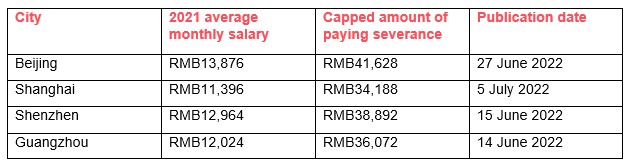
New average monthly salary in major cities released. Recently many major cities in China announced their average monthly salary figures from 2021. Severance payments are calculated by the number of years worked at the rate of one month’s salary for each full year worked but are capped at no more than 3 times the average local monthly salary. It is therefore important to keep abreast of these figures. We have summarised the 2021 average monthly salary of a few major cities and calculated the corresponding capped severance amounts:
Guidelines on Labour Dispatch in the Yangtze River Delta Region. On July 26, 2022, the labour authorities of Jiangsu Province, Shanghai Municipality, Zhejiang Province and Anhui Province of China published the Compliance Guidelines on Labour Dispatch in the Yangtze River Delta Region (“Guidelines”) online. In the Guidelines, the labour authorities have, among others, made a clear distinction between labour dispatch and labour outsourcing, which is of great guiding significance to avoid the “fake labour outsourcing and real labour dispatch” that often occurs in practice. The major distinctions are reflected in the following aspects:
Qualification: A labour dispatch entity must obtain the Labour Dispatch Operation License, while in a labour outsourcing relationship, there are no special qualification requirements.
Position and quantity: Labour dispatch can only be carried out in temporary, auxiliary or alternative positions, and the number of the dispatched staff used by a host entity shall not exceed 10% of its total number of staff. However, there is no such position and quantity limitation for labour outsourcing.
Legal relationship: In a labour dispatch relationship, the hosting entity and the dispatched staff have an actual labour-use relationship. In a labour outsourcing relationship, however, there is no employment/ labour-use relationship between the principle and the staff used by the contractor.
Direction and management: In a labour dispatch relationship, the host entity directly commands and manages the daily work of the dispatched staff, and the dispatched staff shall follow the rules and regulations of the host entity. In a labour outsourcing relationship, the contractor directly commands and manages its staff, the principal does not participate in the management.
Measurement of work achievements: In a labour dispatch relationship, the host entity pays the labour dispatching entity for its services based on the number of the dispatched staff, the content and/or hours of work. In a labour outsourcing relationship, the principal pays the contractor for the outsourced services based on its completion, which is not directly related to the number of staff used by the contractor or their working hours, etc.
Applicable laws: Labour dispatch is mainly governed by the Labour Contract Law, the Measures for the Implementation of Administrative License for Labour Dispatch and the Interim Provisions on Labour Dispatch. In contrast, labour outsourcing is mainly subject to the Civil Code.
Please contact our team in the PRC if you require further detail on these guidelines.
Singapore
Future of hybrid working. As some European jurisdictions re encouraging post-Covid permanent flexible working arrangements, all signs point to a light-touch regulatory approach in Singapore.
However, the Tripartite Partners have thrown down the gauntlet by encouraging employers] to offer permanent flexible work arrangements as we transition to a post-COVID world. A set of Tripartite Guidelines will also be introduced by 2024, which will make it mandatory for employers to fairly consider all flexible work requests.
It will be interesting to see how companies adapt to these new requirements in Singapore, particularly against the backdrop of a concerted push by global senior management to get employees back into the office.
Please contact our team in Singapore if you require further detail.
Spain
EU Directive on Transparent and Predictable Working Conditions. From 28 June 2022, following a public consultation, Spain has been drafting the document to transpose the Directive. Please contact our Spanish team for further detail about the transposition of this Directive in Spain.
New equal treatment and non-discrimination law. On 13 July 2022, the new Law 15/2022, Integral for equal treatment and non-discrimination came into force. Although this new law includes rights and protections already covered by Spanish law, there are various new regulatory aspects employers need to be aware of. Also, the new Law includes a provision that indicates what may be the next regulatory development in equal pay, with the possibility of companies with more than 250 employees being required to publish the salary information necessary for analysis of the factors leading to salary differences, taking into account the conditions or circumstances that maybe the cause of discrimination. We have highlighted the key aspects that employers need to know here.
UAE
Changes to the Federal UAE labour and employment laws. A new law came into force in February 2022 followed quickly by the publication of Regulations applying to all employers in the UAE with the exception of those in the Dubai International Financial Centre (DIFC) and the Abu Dhabi Global Market (ADGM) financial centre free zones.
Although the scope of the Executive Regulations is somewhat limited, and we expect further regulations to be issued in due course. The top 10 points cover:
Employee handbook / policies. Only companies with 50 or more employees to ensure they implement a handbook or policies.
End of Service gratuity (EOSG). Calculation of this is clarified to be on the basis of calendar days. Employers can apply the old law on EOSG for existing employees still on unlimited contracts until they are transferred to fixed term contracts or 01 February 2023 (whichever is sooner).
Discrimination & harassment. New discrimination protections offered to employees, specifically on the grounds of race, colour, sex, religion, national origin, social origin and disability. Bullying and sexual harassment protection has been introduced. Equal pay is required for men and women in the same work.
Flexible working. The ability to work on full-time, part-time, temporary or flexible basis and the ability to work remotely on a job share or freelance basis. Regulations also set out how to calculate annual leave for part time workers.
Working hours. Categories of employers exempted from the maximum limit on working hours.
Carrying over annual leave. Employees have the right to carry over up to half their accrued but unused annual leave entitlement into the following year (or agree a payment in lieu).
Parental leave. A condition to provide evidence of birth is now required. Further guidance required around adoption leave.
Sick leave. An employee is not entitled to sick leave if the illness results from misconduct (at work or otherwise), or for reasons relating to, for example, drugs or alcohol (subject to medical or other evidence).
Termination due to employer’s bankruptcy / insolvency. Confirming earlier analysis that a simple financial loss or “cut-back” is insufficient to trigger such termination.
Restrictive covenants. Non-compete clauses must have reasonable geographical scope, be limited to type of work and cannot be for longer than two years.
Following the deadline of 01 February 2023, non-compliant firms face fines up to AED 1,000,000 for a single violation or up to AED 10,000,000 for repeated violations.
For a breach to the new discrimination and harassment provisions, fines between AED5,000 to AED1,000,000 (with risks of multiple fines for the number of employees impacted by the breach).
Further information on this is available in our Insight here.
Repapering of employment contracts in the UAE with Simmons Wavelength. We have been assisting clients with updating their employment contract templates and policies in compliance with the new UAE Labour Law above and have witnessed a considerable administrative burden associated with this repapering exercise, particularly when they have a lot of employees in the UAE. It is a headache for HR teams to process the amendments for each employee, keep track of which employees have executed a new contract and also ensure that accurate records are maintained for renewal of fixed term employment contracts. Fortunately, we have a legal engineering division within Simmons Wavelength that can support with your update and amendment processes. The UAE employment team work closely with our legal engineers and they have supported many similar projects around the world. Using automation technology and process design, our solutions are bespoke, flexible and can work with your HR and IT systems.
For further information on what appropriate arrangements are required or to ease the administrative burden associated with this repapering exercise please contact our UAE team.
DIFC (Dubai International Finance Centre)
New UAE Visa options. A number of new UAE visa options have been announced by the authorities. These are due to come into effect during October 2022 and are primarily aimed at offering flexible options for individuals to visit, live and work in the UAE without having a traditional “sponsor” or employee / employer relationship.
Remote working and implications for DFSA Regulated Entity employees. On 26 April 2022, the DFSA published a letter setting out its recommendations for employees of DFSA Regulated Entities in the DIFC, carrying out regulated activities and remote working or working from home. In short, the DFSA’s view is that Regulated Entities should be providing financial services “primarily in or from” the DIFC (that is, those individuals providing financial services should be physically present in the DIFC when the services are being delivered). In particular, senior management of Regulated Entities should be “spending the clear majority of their time in the DIFC”.
New DFSA Whistleblowing Regime. The DFSA introduced a new regulatory regime for whistleblowing with effect from 7 April 2022, which applies to all DFSA “regulated entities” operating within and from the DIFC, with the intention of providing enhanced legal protection to employees, officers or agents of a regulated entity that have reported misconduct (either internally or externally to the regulated entity’s auditors or the DFSA or any other law enforcement agency).
For further information these updates please contact our UAE team.