Draft VBER and Vertical Guidelines published by the EU Commission
On Friday 9 July 2021, the EU Commission published the draft new regulation on vertical restraints and the draft Guidelines on Vertical Restraints.
On Friday 9 July 2021, the EU Commission published the draft new regulation on vertical restraints ("VBER") and the draft Guidelines on Vertical Restraints ("Guidelines") (see press statement). The two documents might be subject to further amendments before their final publication, but early awareness as to upcoming changes is of key importance for practitioners.
Background
The current Regulation n°330/2010 helps identifying admissible practices under Article 101 TFEU and provides for a safe harbour for vertical agreements, ie agreements for the sale, purchase or resale of products between undertakings active at different levels of the value chain. This Regulation will expire in May 2022.
To better address the current needs of the market and make the future VBER as futureproof as possible, a thorough review process, involving several public consultations, has been launched by the Commission in 2018. As result, the Commission has published in September 2020 a Staff Working Document and in October 2020, an inception impact assessment outlining the policy options it has identified.
After having conducted a further public consultation which ended in March 2021, the EU Commission has now just published a draft new VBER and draft new Guidelines.
Overview of the key issues in the draft VBER and Guidelines
In the following we highlight the key issues in a non-exhaustive list. The draft VBER and draft Guidelines provides for a variety of further topics such as analysis of agency agreements, of non-compete clauses, of agreements concluded between SMEs, of price comparison tools, of selective and exclusive distribution networks.
Dual distribution1
Current law / approach
Dual distribution agreements can be block-exempted under the same conditions as other distribution agreements.
Ref.: article 2(4)(a) and (b) of the current VBER
Changes in the draft
Dual distribution can be block-exempted pursuant to specific new conditions.
main test (four cumulative conditions that apply if the combined market share of the parties at retail level is below 10%):
- the subject matter of the agreement does not fall within the scope of another block exemption;
- the supplier's and the buyer's aggregate market share in the relevant market at retail level does not exceed 10%;
- it covers situation where the supplier is either a manufacturer, wholesaler or importer and is also a distributor of goods or services while the buyer is only a distributor that does not compete with the manufacturer on the upstream level; and
- the agreement does not contain any horizontal restrictions by object.
alternative test (five cumulative conditions that apply when the combined market share of the parties at retail level is above 10% but the market shares of the supplier does not exceed 30% of the relevant market on which it sells the contract goods and services and the market shares of the buyer does not exceed 30% of the relevant market on which it purchases the contract goods and services):
- the subject matter of the agreement does not fall within the scope of another block exemption;
- the parties' market share in the relevant markets does not exceed 30% and does not contain any hardcore restriction under the VBER;
- it covers situation where the supplier is either a manufacturer, wholesaler or importer and is also a distributor of goods or services while the buyer is only a distributor that does not compete with the manufacturer on the upstream level;
- any exchange of information between the parties is compatible with the Horizontal Guidelines; and
- the agreement does not contain any horizontal restrictions by object; and
suppliers of online intermediation services that have a hybrid function (ie they provide online intermediation services to companies and sell the same products/services as these companies) are not covered by VBER.
Ref: Article 2 4 (a) (b) and (5) of the draft VBER, paras. 83 and seq. of the draft Guidelines
Restriction on active / passive sales
Current law / approach
Restriction on active and passive sales are regulated by Article 4 of the VBER. Under the current framework, a supplier cannot, notably, prohibit passive sales to a territory where there is a selective distribution network.
Ref : article 4(b) of the current VBER, paras. 51 and seq. of the current Guidelines
Changes in the draft
The draft VBER and Guidelines clarify the definition of active and passive sales, notably in the context of online sales, and set out what is permissible under each category of different distribution networks.
In addition, under the draft VBER, it is now possible to (i) restrict in all distribution systems a buyer and its customers from actively or passively selling to unauthorised distributors in a territory where the supplier operates a selective distribution system or which the supplier has reserved for the operation of such systems ; and (ii) restrict the place of establishment of a buyer2.
Ref: Article 4 (b) (c) (d) of the draft VBER and paras. 197 and seq. of the draft Guidelines
Dual pricing3
Current law / approach
Dual pricing is considered as a hardcore restriction under the current Guidelines.
Ref : para. 52 of the current Guidelines
Changes in the draft
Dual pricing can benefit from VBER in so far that the pricing policy has as its object to incentivise or reward the appropriate level of investments respectively made online and offline.
Ref : para. 195 of the draft Guidelines
Restrictions on the use of online marketplaces
Current law / approach
Under the current Guidelines, there is no specific indication on the use of online marketplaces.
EU and national case law has confirmed that it is possible to restrict the use of online marketplaces.
Changes in the draft
Restricting the use of online marketplaces can benefit from the block exemption irrespective of the distribution system used by the supplier provided that it does not prevent distributors or their customers from effectively using the internet.
When the 30% market shares threshold is exceeded, it is necessary to examine whether the restriction on the use of marketplaces will restrict competition.
Ref: paras. 194 and 313 and seq. of the draft Guidelines
Parity obligations4 (or “most-favoured nation clauses”)
Current law / approach
Most-favoured nation clauses can lead to indirect prohibited resale price maintenance under the Guidelines. There are several types of parity clauses including wide parity clauses5 and narrow parity clauses6. Several competition authorities have considered that wide parity clauses can be restrictive of competition.
Ref: para. 48 of the current Guidelines
Changes in the draft
Across-platform retail parity obligations are obligations which cause a buyer of online intermediation services not to offer, sell or resell goods or services to end user under more favourable conditions using competing online intermediation services. They cannot benefit from the block exemption and a case by case analysis should be conducted.
Ref: Article 5(1)(d) of the draft VBER, paras. 333 and seq. of the draft Guidelines
Resale price maintenance (“RPM”)
Current law / approach
RPM is considered as a hardcore restriction under the VBER. Prohibited practices can take the form of mandatory minimum resale prices as well as recommended resale prices or maximum resale prices when they in effect restrict the ability of the distributor to freely fix its prices.
Even though RPM can in theory lead to efficiencies and be thus admissible, competition authorities in the EU have had a very strict approach to date.
Ref: article 4(a) of the current VBER and paras. 223 and seq. of the current Guidelines
Changes in the draft
RPM is considered as a hardcore restriction and the Guidelines explain in more details how to assess the effects of recommended or maximum prices.
The use of price monitoring software and the fixing of a resale price in a vertical agreement between a supplier and a buyer that executes a prior agreement between the supplier and a specific end-user (ie a fulfilment contract) do not constitute RPM.
Ref: Article 4 (a) of the draft VBER ; paras. 170 and seq. of the draft Guidelines
Non-compete clauses
Current law / approach
Non-compete clauses that lasts for an indefinite term or more than five years or for a period that is tacitly renewable beyond a period of five years are not covered by VBER.
Ref: article 5 (1) (a) of the current VBER, paras. 66 and seq. of the current Guidelines
Changes in the draft
Non-compete clauses that are tacitly renewable beyond a period of five years are covered by the block exemption provided that the buyer can effectively renegotiate or terminate the vertical agreement containing the obligation with a reasonable notice period and at a reasonable cost, thus allowing the buyer to effectively switch its supplier after the expiry of the five-year period.
Ref: article 5 (1) (a) of the draft VBER and paras. 233 and seq. of the draft Guidelines
Next steps
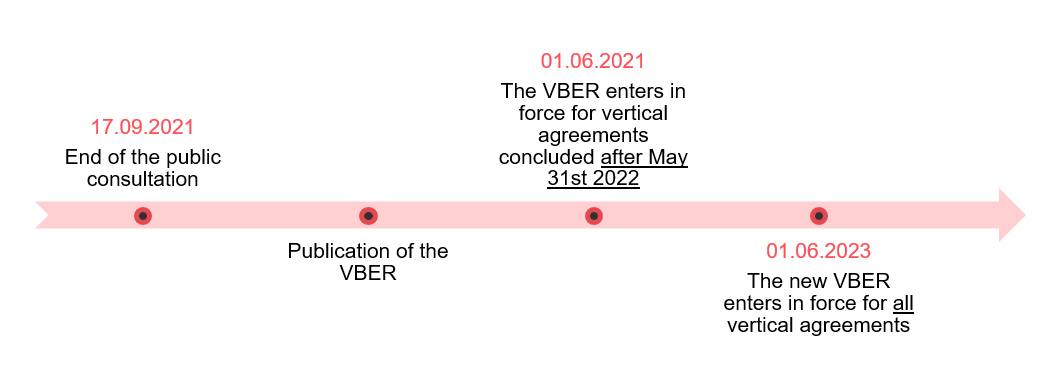
The Commission invites all interested parties to submit their comments by 17 September 2021 and the intended timeline for the implementation of the new VBER is the following7:
1A supplier sells directly to end-customers and via distributors.
2This is already possible in specific instances under the current VBER.
3The same distributor pays a higher price for products intended to sold online than products intended to be sold offline.
4Obligations to give similar or better conditions to the other party compared to the other conditions given to third parties or via the supplier’s own sales channel.
5Parity obligations which refer to all sales channels.
6Parity obligations which refer to direct sales channels operated by the supplier.
7See article 9 of the draft VBER.

.jpg?crop=300,495&format=webply&auto=webp)


.jpg?crop=300,495&format=webply&auto=webp)
_11zon_(1).jpg?crop=300,495&format=webply&auto=webp)