


30 September 2026Publication
AI governance for high-growth companies
Fast-growing companies are using AI to scale at unprecedented speed. Governance can help turn that advantage into sustainable growth.
Article 4 of the EU AI Act requires providers and deployers of AI systems to ensure a sufficient level of AI literacy of their staff from Feb 2025. We have developed a bespoke literacy approach, including e-learning course, to help you comply.
Are you using AI in your organisation and need some advice around this obligation?
Complete the form below and one of our team will get back to you as soon as possible.

Please see frequently asked questions below.
Any organisation which has AI users and developers must ensure that their staff have a sufficient level of skill, knowledge and understanding to make informed decisions about AI deployment, and are aware of the opportunities, risks and potential harm AI can cause.
1st February 2025 - 6 months after the AI Act entered into force.
Simmons & Simmons has developed an AI Literacy Programme, tailored to meet this obligation under the Act. The programme is ready to go and includes an e-learning module providing foundational AI training for staff.
Yes.
Not necessarily. Simmons can offer a GAP analysis of your existing programme and provide detail around what else needs to be implemented to achieve compliance by Feb 2025.
The required level of AI literacy depends on staff's technical knowledge, education and experience, and the context and target of AI use. Our tiered approach to AI literacy is outlined in the diagram below: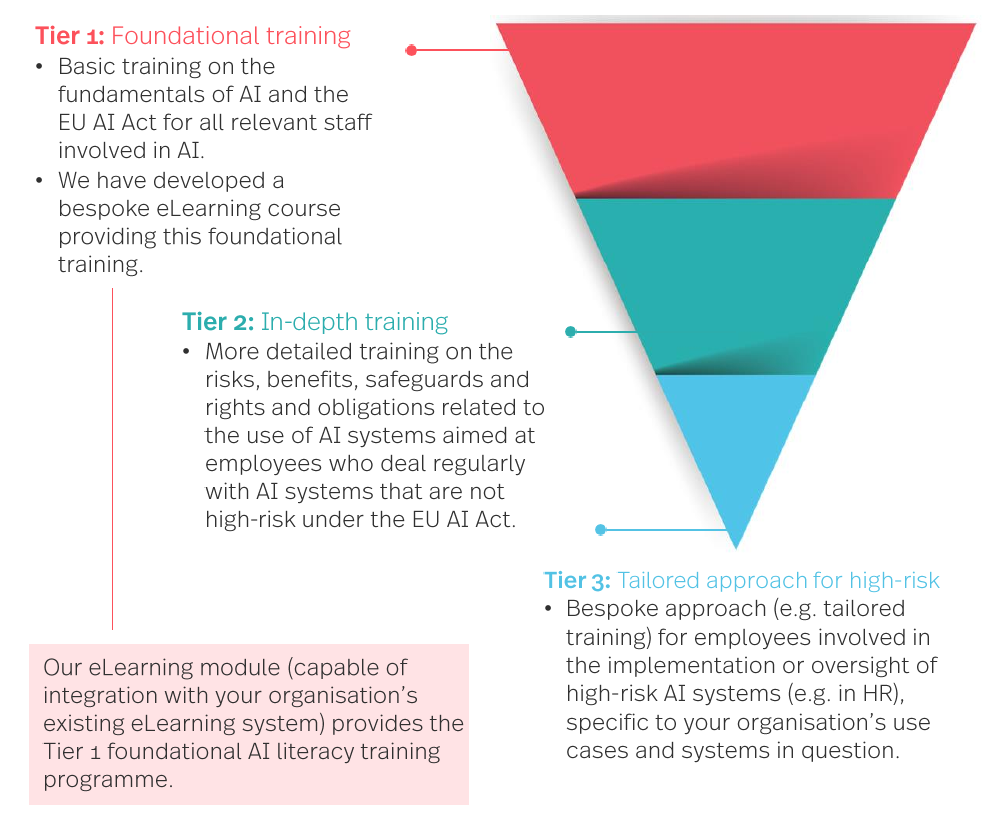
Get in touch to discuss how we can help you reach the February 2025 deadline.
Article 4: "Providers and deployers of AI systems shall take measures to ensure, to their best extent, a sufficient level of AI literacy of their staff and other persons dealing with the operation and use of AI systems on their behalf, taking into account their technical knowledge, experience, education and training and the context the AI systems are to be used in, and considering the persons or groups of persons on whom the AI systems are to be used".
Article 3(56): AI literacy means "skills, knowledge and understanding that allows providers, deployers and affected persons, taking into account their respective rights and obligations in the context of this Regulation, to make an informed deployment of AI systems, as well as to gain awareness about the opportunities and risks of AI and possible harm it can cause".
Complete the form and one of our team will get back to you to discuss how we can support you.
This document (and any information accessed through links in this document) is provided for information purposes only and does not constitute legal advice. Professional legal advice should be obtained before taking or refraining from any action as a result of the contents of this document.
If you have any questions, contact a member of the AI Literacy Programme team for assistance:
30 September 2026Publication
Fast-growing companies are using AI to scale at unprecedented speed. Governance can help turn that advantage into sustainable growth.
.jpg?width=380&width=380&format=webply&auto=webp "Article")
28 September 2026 Publication
Our fortnightly round-up of key AI legislative, regulatory and policy updates from around the world
.jpg?width=380&width=380&format=webply&auto=webp "Article")
23 September 2026 Publication
In an AI-enabled profession, the most valuable lawyers will not be the ones who generate answers the fastest, but the ones who know how to question them.

09 September 2026 Publication
As AI changes how legal work is delivered, how should firms organise their people, knowledge and expertise around it?

04 September 2026 Publication
If lawyers have always learned by doing, what happens when AI does more? Our experts explore how firms can rethink learning to create a future-ready workforce.