Generative AI (GenAI) is transforming the workplace, but how do you get the best out of it? How can it help you to save time and effort while ensuring reliable results?
The skill is to master the craft of effective prompts, because GenAI can only ever be as good as the human piloting it. Taking a loan agreement as an example, here are Lucy’s top tips for effective legal prompts.
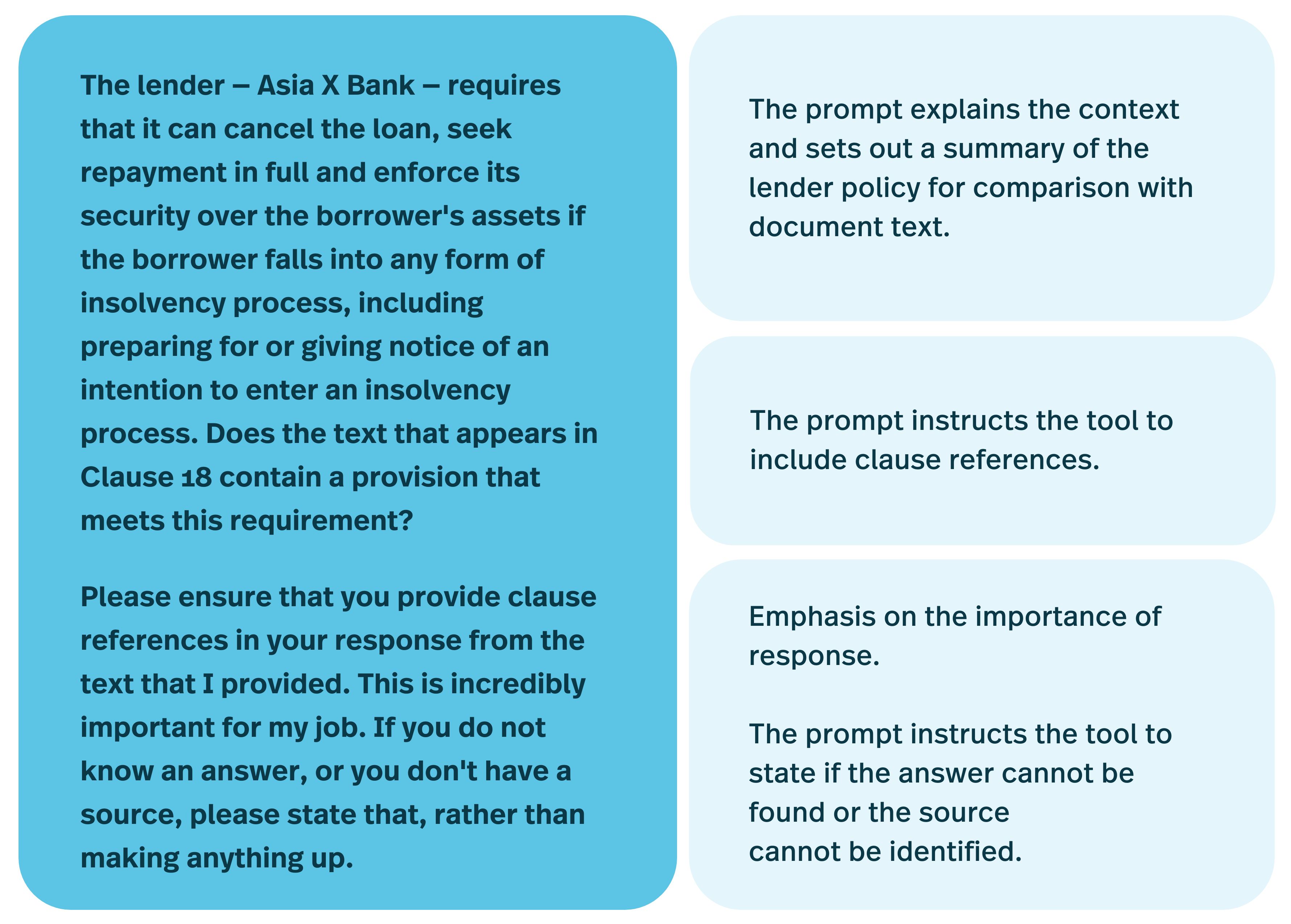
Explain: Specify the role that you want GenAI to take on. You might, for instance, explain that you’re a professional lawyer, working for a bank, and you want the tool to review the terms of loans being made to borrowers in Asia.
Context: GenAI needs context to work effectively. It needs to know what you know. Provide background information to bring it up to speed, so that it understands the task and can respond accurately. Tell it, for instance, that the information will be used to help prospective investors to understand the biggest risks in a transaction and to decide whether or not to invest. Precision is, therefore, very important.
Single prompt: Don’t over complicate it. You’ll get better results by focusing on one task or objective per prompt.
Structure: How do you want your content to look? Tell the GenAI tool how to structure the output. You can always refine the prompt by asking it to convert copy into bullet points, or a list into a table.
Tone: GenAI needs guidance on how you want to come across. For example, you might instruct it to be professional, clear and concise, and to reference specific clauses in the loan agreement.
Refine: Be prepared for some back-and-forth. Refine your prompt instructions until the tool understands exactly what you want it to do, and you get the outcome you need.
Some organisations create prompt libraries, meaning you can search for examples of prompts that have been done before, instead of starting from scratch.
Reference check: Don’t believe blindly in what GenAI tells you. It is known to make things up. Ask the GenAI tool to include references to show where information can be found in source materials.
Negative summaries: Flip the prompt. First, ask the GenAI tool to generate a summary of content. And then send a new prompt, asking it to list any points it has omitted from the summary. This two-step approach helps to ensure that all pertinent details are covered.
Interrogate outputs: Ask follow-up questions, seek confirmation of key points, find out how a response has been generated.
There is a skill to crafting AI prompts. At first, you might think you could do the work more quickly yourself. But with practice, you’ll develop the skills to hone the AI prompts and get reliable answers more quickly.


.jpg?crop=300,495&format=webply&auto=webp)
.jpg?crop=300,495&format=webply&auto=webp)




_11zon.jpg?crop=300,495&format=webply&auto=webp)

.jpg?crop=300,495&format=webply&auto=webp)






.jpg?crop=300,495&format=webply&auto=webp)
.jpg?crop=300,495&format=webply&auto=webp)