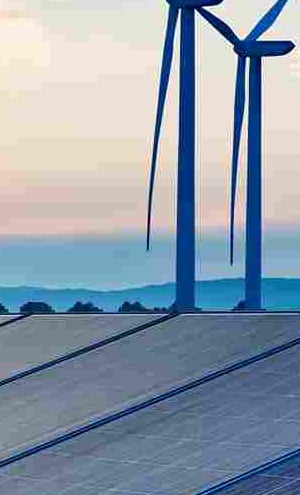
Sustainability is set to drive rapid growth and revive the economy.
While the world is in a period of economic re-evaluation and evolution, sustainability is a sector on the brink of rapid expansion, driving economic resurgence.
“The world seems to have understood that something needs to change in order to safely co-exist on Earth over the long term,” says Dr Jens Gölz, a partner in our Frankfurt office specialising in renewable, energy and infrastructure projects. “This new mindset has opened the market for businesses and investors in sustainability.”
As we’ll explore in a series of articles and research in the run up to this year’s COP28 conference, this shift in the global mindset offers ample opportunities.
The greatest of these lies in green technologies such as “e-fuels, electronic cars, green chemistry, wall boxes, water and air purification, and the adoption of renewable energy sources,” says Gölz.
But there are many more routes to growth and opportunity in sustainability, from reimagining products, services and supply chains, to rethinking finance, investment and human resources.
Now is the time to act. Sustainability has been on the business agenda for decades, but the policy and financial environment needed to support bold investment is finally falling into place.
That’s not to say there won’t be any challenges. The sustainability landscape is set to unleash a new wave of competition between businesses, not just for investment but also employees, suppliers, customers and more besides. Fortune will favour those who grasp the opportunity to transition first.
A fertile ground for finance
The capital available for transitioning to a sustainable global economy has fallen short to date. The International Monetary Fund reported in late 2022 that $3tn to $6tn needs to be invested every year until 2050 to effectively mitigate against climate change. Until recently, it found, only about $630bn a year had been committed.
But this is beginning to change. In 2020, 40 of the world’s largest financial institutions stepped up their engagement with the sustainable development goals, according to a study by the Capital as a Force for Good Initiative, deploying $2.1tn of financing towards the goals.
Islamic finance is proving to be an especially fertile ground, thanks to the close match between Islamic investment values and environment, social and governance (ESG) requirements.
“ESG is a massive opportunity in Islamic finance because there is large overlap,” says Muneer Khan, a partner and our Middle East regional head. “When one of our Saudi Arabia-based Islamic asset manager clients developed its Luxembourg-domiciled ESG-focused, Shariah-compliant equity fund, it found a 98% convergence between their Shariah screen and the relevant ESG screens.”
Khan says high prices for hydrocarbons have given Middle Eastern countries such as the UAE, Saudi Arabia and Qatar a chance to invest now, to diversify from oil and gas tomorrow.
“There's a real financial imperative for these economies to make themselves less dependent on hydrocarbons and less vulnerable to changes in the oil price. The pace and scale of diversification efforts have switched up a gear,” says Muneer Khan, a partner and our Middle East regional head.
Large investments in sustainable and green centres like Saudi Arabia’s Neom and the UAE’s Masdar show the scale of investment in the region. COP28 will further shine the spotlight on the Middle East, as the world’s public and private finance entities collectively assess their contributions to sustainable finance.
An evolving policy framework
The new investment available for sustainability has been unlocked in large part by ambitious policy.
President Biden’s recent Inflation Reduction Act, for example, featured green incentives and subsidies worth some $369bn. This triggered European policymakers to offer similar support with its new Green Deal Industrial Plan, worth $270bn.
This ramping up of government investment is reminiscent of the space race, but with a sustainable goal.
Meanwhile, global alignment on the sustainability agenda is clearing the way for investible opportunities. This can be seen in action on the blue economy: two recent international agreements to protect biodiversity and regulate the high seas have helped to articulate businesses’ dependence on marine habitats, and bolster government support for protecting them.
Combined with an upcoming voluntary standard for blue bonds, these moves will help businesses and investors mobilise their resources.
“Sound policy architecture is critical for scale and its arrival makes sustainability a coiled spring ready for release,” says Sonali Siriwardena, partner and our global head of ESG.
Working together
Competition is the driving force behind markets, and businesses are already jostling to position themselves ahead of rivals in the sustainability transition. But given the scale and complexity of many sustainability challenges, collaboration between businesses could be even more powerful.
While anti-ESG headwinds are impacting opportunities for collaboration in the US, other jurisdictions, including Greece, the UK and the Netherlands, are clearing the way for businesses to work together on sustainability initiatives without falling foul of competition law.
This is already having an impact. For instance, with the blessing of the Dutch competition authority, soft-drink suppliers including Coca-Cola and Vrumona, and supermarket chains Albert Heijn and Jumbo, have collaborated to discontinue plastic handles on all soft-drink and water multipacks.
Businesses that operate in multiple jurisdictions tend to apply the standards of the strictest regimes in which they operate across their organisation, as it is costly to apply different rules in different geographic divisions.
Convergence among the regulatory superpowers could prove transformational, explains Mark Jephcott, partner in our competition group.
“The chair of the US Federal Trade Commission has warned that sustainability is not an excuse to break competition law – which it isn't, and no one is saying it is,” he says. “But there is an opportunity for the EU and US to make a difference here, and one has to be optimistic in this game.”
Dynamic business regulation
It’s worth remembering that, as new investment opportunities in sustainability open up, the regulations that determine businesses’ obligations will also solidify, further cementing the need for executives and investors to take action.
Now, the stage is set for businesses and investors to approach sustainability in a new way: as a profitable ecosystem of business opportunity, innovation and confident compliance in pursuit of the greater good for the planet.
In our ‘Opportunity in sustainability’ series, we’ll discover how businesses and investors are doing just that.
Start now, with our article examining the blue economy.





.jpg?crop=300,495&format=webply&auto=webp)
_11zon.jpg?crop=300,495&format=webply&auto=webp)




_11zon.jpg?crop=300,495&format=webply&auto=webp)

.jpg?crop=300,495&format=webply&auto=webp)