Brexit flash note: Fish and PRIIPs
Having missed deadlines not seeking an extension to the Transition Period, it is increasingly likely that the UK will enter 2021 with no FTA and on WTO terms.
We have previously published our view that the UK will miss its end-June deadline to agree terms for financial services equivalence - and for fish; the ‘Fish and PRIIPs’ of our title! And having missed those deadlines (see graphic overpage) that the UK will also not seek an extension to the Transition Period (TP). That raises the likelihood that the UK enters 2021 with no FTA, no extension and onto WTO terms – a scenario to which we estimate financial markets appear to ascribe a 40% probability. Recent statements from Chancellor (Finance Minister) Rishi Sunak reinforce that scenario. Our further analysis suggests it could conflate with two other elements later this year, the ending of COVID furloughs and the US Presidential election, to create a chaotic backdrop to an already challenging environment for the corporate sector.
Fish and PRIIPs – two sides of the 40% chance for WTO
Chancellor Sunak said this week that while he believed that “comprehensive findings of equivalence” would be in the best interests of both parties he nonetheless wanted to “tailor” capital rules for insurers (Solvency II) and PRIIPs. Such ‘tailoring’ would likely raise warning flags for the EU around future regulatory divergence making less likely the chances for a deal. That in turn would underscore the 40% chance of WTO in 2021 that we estimate financial markets ascribe to that outcome.
Scenario element: Brexit and COVID
Furlough schemes in the UK are being tapered from the end of July through to end of October when they are currently due to finish. That period will be one in which the risk of insolvency could rise. It is also the period when lockdown provisions will be relaxed even further so raising the risk of further outbreaks. Whether or not such outbreaks are sufficient in scale to constitute fully a “second wave” requiring further national lockdown, even localised rolling lockdowns could cause further economic dislocation. Recall that the OECD in its latest forecasts has a 50% scenario in which the UK and other countries suffer a second wave during Q3 causing significant economic dislocation. Such a scenario would make the second half of 2020 even more chaotic than currently contemplated and could raise the probability of seeking a form of ‘force majeure’ extension to the TP . Or would the government risk a chaotic exit onto WTO terms with a second wave underway through winter?
Scenario element: Brexit and US politics
The US Presidential election is on 3 November 2020. By the time of the European Council meeting on 15-16 October polls may be pointing more clearly in one direction or another. If it’s looking like Biden that may tip the balance for some in the UK government to take a softer line with the EU, anticipating a very different world order post that election. As reported widely (e.g. here) those around Biden see advantage in the UK staying close to the EU and have particular concerns to see the continuing operation of the Northern Ireland Protocol. In that event (Biden ahead in the polls) PM Johnson may take a softer tack with the EU rather than risk isolation from the US.
Forthcoming scenario analysis
We will bring these different elements together in a forthcoming and comprehensive scenario analysis. Meanwhile I hope you will be able to join me and other senior colleagues at 9am (BST) on 30 June at a webinar where we will be describing these and other features of the road ahead leading to the UK’s new trading relationship not just with the EU but the wider world also.
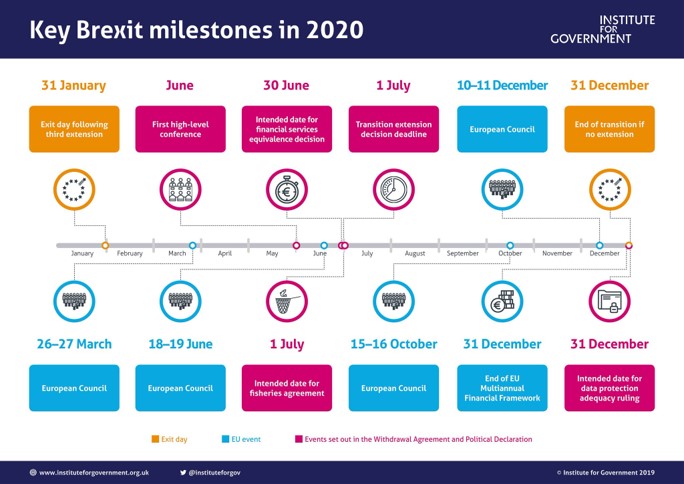
The graphic below courtesy Institute for Government, summarises remaining formal key milestones for 2020. Given past experience, notably over the Withdrawal Agreement, it should be taken as a guide only. The opportunity/need for ‘last minute’ flexibility may be huge and irresistible – note the “intensified” talks about to get underway with two further negotiating rounds, face-to-face, in Brussels and then in London. Note also Michel Barnier describing the October European Council meeting as “the moment of truth” when negotiating teams must agree a draft deal if there is to be time for it to be ratified by the UK and all EU 27 parliaments in time for 2021.