The right infrastructure will allow you to go beyond the storage and management of your data to effectively analyse it, too. Ultimately, the goal should be to gain as close to real-time insight as possible. The world of data infrastructure moves quickly. The emergence of new digital technologies and regulations are changing the rules of the game. We set out how data leaders are staying one step ahead.
In our study, 76% of data leaders say their data infrastructure is optimised for data commercialisation. This compares to just 42% of laggards.
We set out the five behaviours that allow data leaders to easily extract tangible value from their data assets.
They favour in-house builds
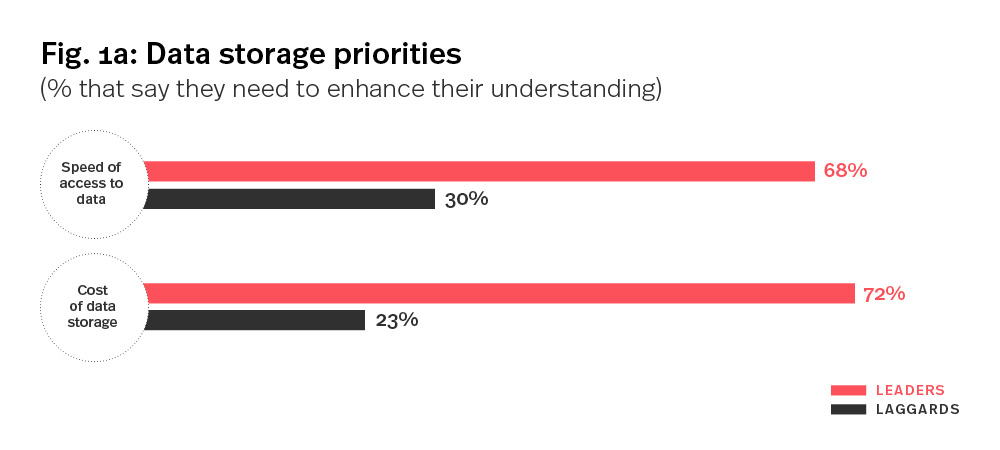
The first thing you need to decide is whether you will buy or build your data infrastructure. Interestingly, our research reveals data leaders prioritise in-house solutions, with just 30% buying data analytics software from third-party providers (Fig. 1). Building your own data infrastructure is often a more expensive and risky option. Yet it is also true that it allows you to create bespoke solutions that fit your specific needs. Similarly, using a platform that is not readily available to the market could deliver a competitive edge.
We have the same challenge that everybody else does around the globe: we have a lot of legacy infrastructure. We have a ‘lift and shift’ approach to move into the new world. But it is a slow process. To speed this up, we’re using third-party cloud services such as Amazon and Microsoft. – a Chief Data Officer
They chase lightning-fast insights
The market leaders of the future will be those that unearth data-driven insights the fastest. There’s no point in finding out that a customer is looking to buy a new smartphone several months after they began browsing or in displaying location-driven or personalised content a few minutes after the customer has left. Data leaders are racing to take pole position. Our research shows that 68% of data leaders prioritise the speed of data access when choosing data storage solutions (Fig. 1a). At the same time, they remain mindful of costs. To balance these sometimes-conflicting priorities, data leaders have turned their backs on on-premise solutions: 76% have now moved their data infrastructure to the cloud.
They embed durable solutions
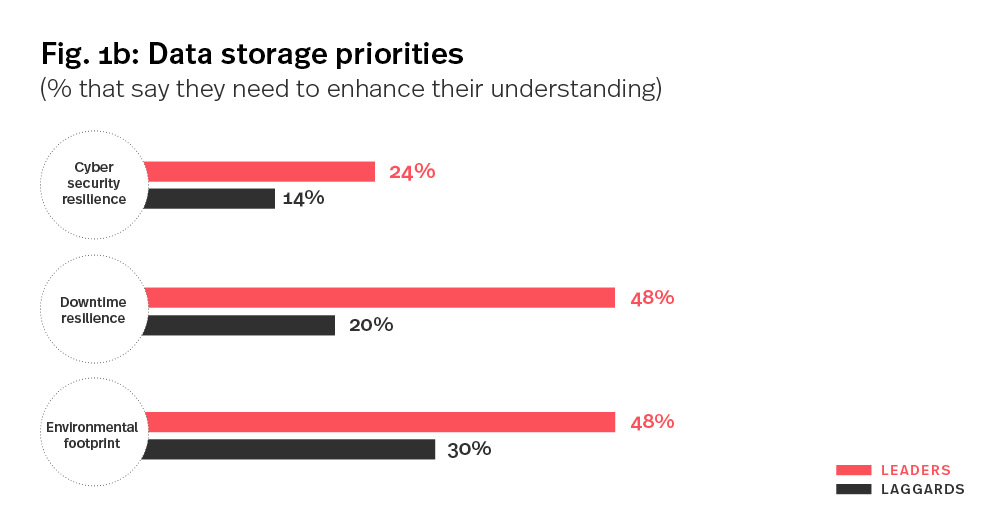
Data protection authorities have flexed their muscles by recently announcing major fines on the likes of British Airways and Marriott. A clear imperative now exists for companies to not only prevent data breaches but also detect and deal with them quickly. Given that context, it is surprising that cybersecurity is not more of a priority for both leaders and laggards (Fig. 1b). Data leaders are, however, concerned with embedding durable infrastructure. They’re twice as likely as laggards to ensure their storage solutions can cope with power outages, natural disasters and other unforeseen events.
They understand the full compliance jigsaw
Pooling data assets from the breadth of your organisation allows you to access richer datasets and richer insights. But sharing data across borders can also trigger data localisation requirements. Data leaders consider this issue much more closely than laggards. In our study, 65% of data leaders think about whether their data storage solutions comply with regulatory restrictions on cross-border data transfers. Just 24% of laggards do the same. Considering this upfront ensures you reach the right decisions around where your data infrastructure is located and who can access your data assets.
They recognise the power of machines
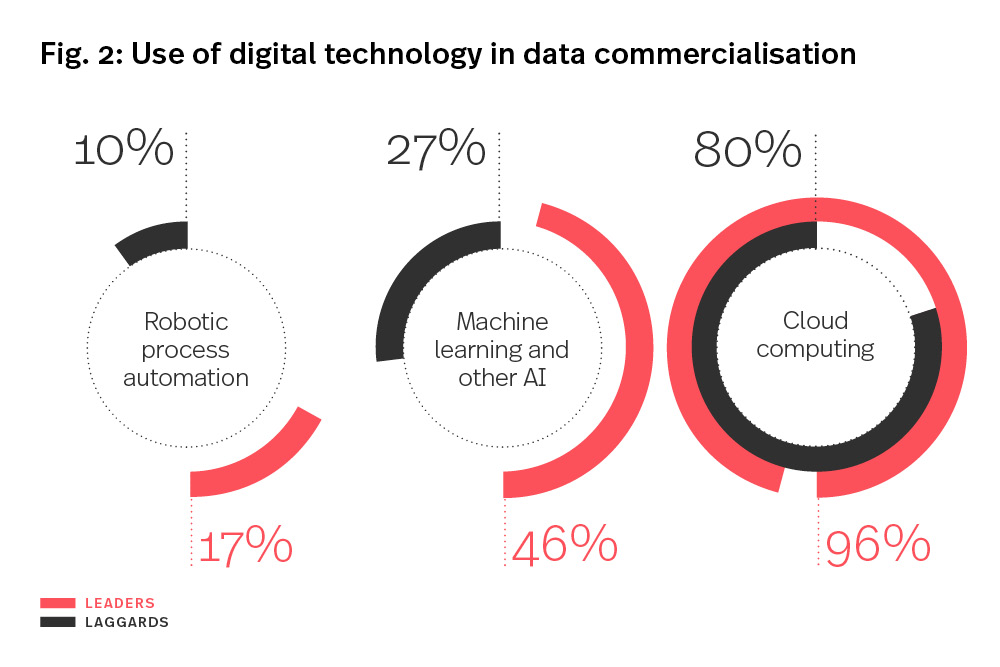
It is impossible to analyse high-volume datasets and find correlations at a sufficient velocity, without the help of advanced digital technology. Data leaders recognise this. They pour money into cloud computing and have started to scale up their adoption of other advanced digital technologies. They’re now twice as likely as laggards to have invested in robotic process automation, machine learning and other artificial intelligence technologies (Fig. 2). As data assets become increasingly large and unstructured, this trend will only accelerate.
So, how do your data commercialisation efforts measure up?
Take our benchmarking tool to find out, and to access exclusive recommendations on how you can win The Big Data Race.
Return to The Big Data Race homepage to find more exclusive insights on data commercialisation.







.jpg?crop=300,495&format=webply&auto=webp)

.jpg?crop=300,495&format=webply&auto=webp)




_11zon.jpg?crop=300,495&format=webply&auto=webp)




.jpg?crop=300,495&format=webply&auto=webp)