To unearth the most powerful business insights, you’ll need to open your data assets to people across your organisation. You’ll also need to develop symbiotic data relationships with third parties. This means striking the right balance between openness, security and compliance. Ultimately, you’ll need to underpin your culture of collaboration with watertight arrangements around privacy, security, regulations and ethics. We set out how data leaders have managed to grasp these thorny issues to create true data democracies across their organisation and beyond.
Big data requires volume. When data it is stored and managed in disparate silos, it becomes impossible to unearth the powerful insights that lead to competitive edge.
Data leaders are significantly ahead of the curve when it comes to sharing and using their data assets effectively. Our research shows that 86% say their executives have all the information they need to manage the business. By contrast, just 61% of laggards can say the same.
We set out the four ways data leaders forge the right connections inside and outside their organisations.
They believe in strength in numbers
Data leaders are more open to data sharing across their business. Our research shows that laggards typically only allow teams to access and use data if its been collected by their own business function. However, leaders regularly allow closely aligned teams to access and use data – for example, sales and marketing, and risk and finance. A further 18% allow business functions to access and use data from across the full breadth of the business.
But they also adopt robust controls
Leaders ensure their culture of data openness is underpinned by robust internal controls. In our study, 75% of leaders consider the ‘sensitivity’ of data when deciding whether it should be made available to other teams. This includes reviewing privacy, security, regulatory and ethical considerations. By contrast, just 45% of data laggards do the same. Without a clear handle on these issues, data collaboration will lead to greater risk, not greater opportunity.
People across the enterprise want their data in different ways. Some people like structured written content but others will prefer a self-service platform, so it’s about suiting the output to the audience and the type of message. – Will Sprunt, CIO, Deliveroo
They adopt flexible approaches to data sharing
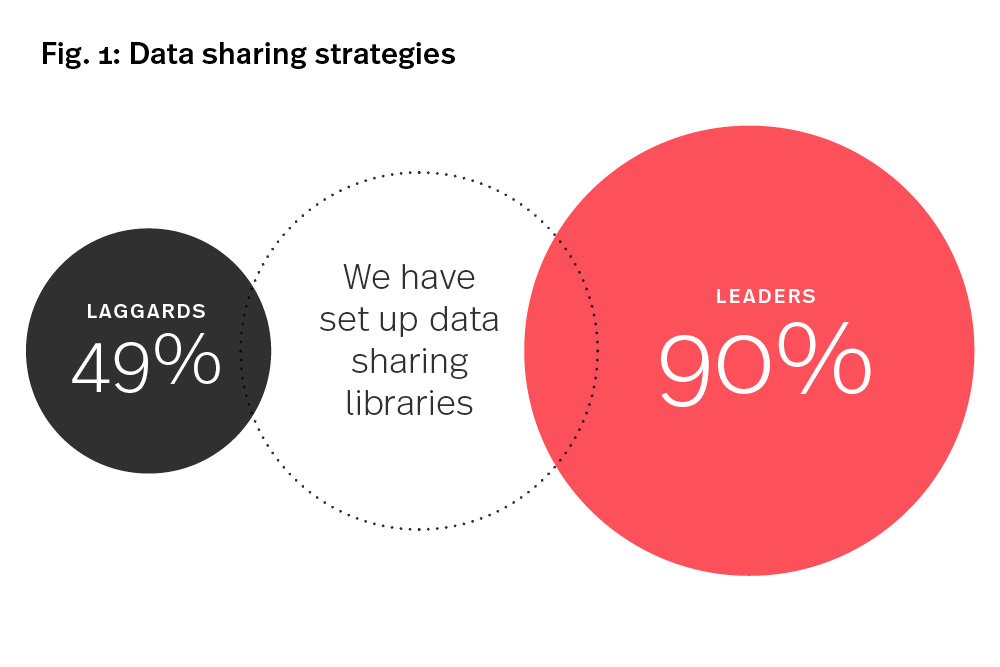
Teams across your organisation have different data needs. They also have different preferences for how they access data assets. Data leaders have been quick to meet this demand. Our research shows 66% adopt a flexible approach to sharing data insights across their organisation. A further 90% have set up data libraries to help employees understand the information that is available to them – nearly double the proportion of laggards (Fig. 1).
They’re willing to work with social media platforms
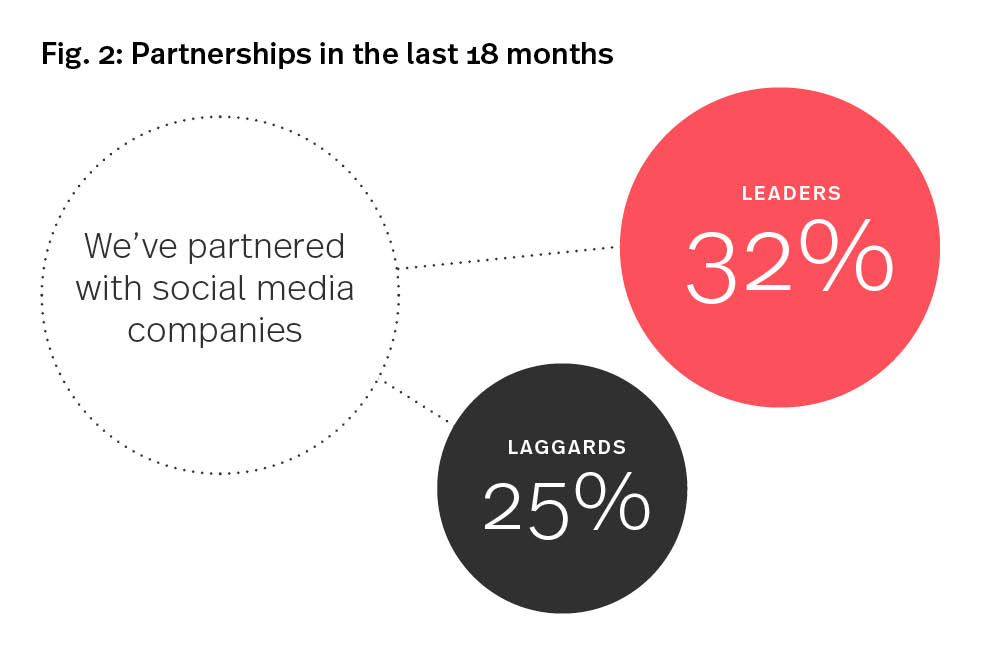
The Facebook/Cambridge Analytica scandal and the French data protection regulator’s fine against Google have created an obvious nervousness around collaborating with digital media platforms. Yet, these organisations offer a deep level of insight around consumer behaviour. This is often the final piece of the jigsaw in your data commercialisation efforts. Data leaders are wary, yet they are proving to be more open to working with social media platforms than data laggards. It’s likely that they have a better understanding of the risks and how to address them as well as what they can achieve from a successful partnership.
So, how do your data commercialisation efforts measure up?
Take our benchmarking tool to find out, and to access exclusive recommendations on how you can win The Big Data Race.
Return to The Big Data Race homepage to find more exclusive insights on data commercialisation.



.jpg?crop=300,495&format=webply&auto=webp)




_11zon.jpg?crop=300,495&format=webply&auto=webp)





.jpg?crop=300,495&format=webply&auto=webp)

_11zon.jpg?crop=300,495&format=webply&auto=webp)