Too many businesses fail to maximise their data because they’ve not invested in the assets that they have or the tools they need to exploit them. At best, this leaves them unable to seize opportunities. At worst, it means they’re unable to effectively manage their business. A strong data governance framework will help you avoid these pitfalls. As our data leaders show, good data governance is not a ‘once-and-done’ exercise. It should be an ongoing, flexible and iterative process. We look at how these organisations adopt robust and sustainable frameworks.
Data leaders take data governance seriously. Overall, 79% say their data commercialisation efforts are underpinned by fit-for-purpose data governance frameworks. By contrast, just 54% of data laggards can say the same.
We set out the four factors that help data leaders establish their thinking around good governance.
They focus on procedures, not just people
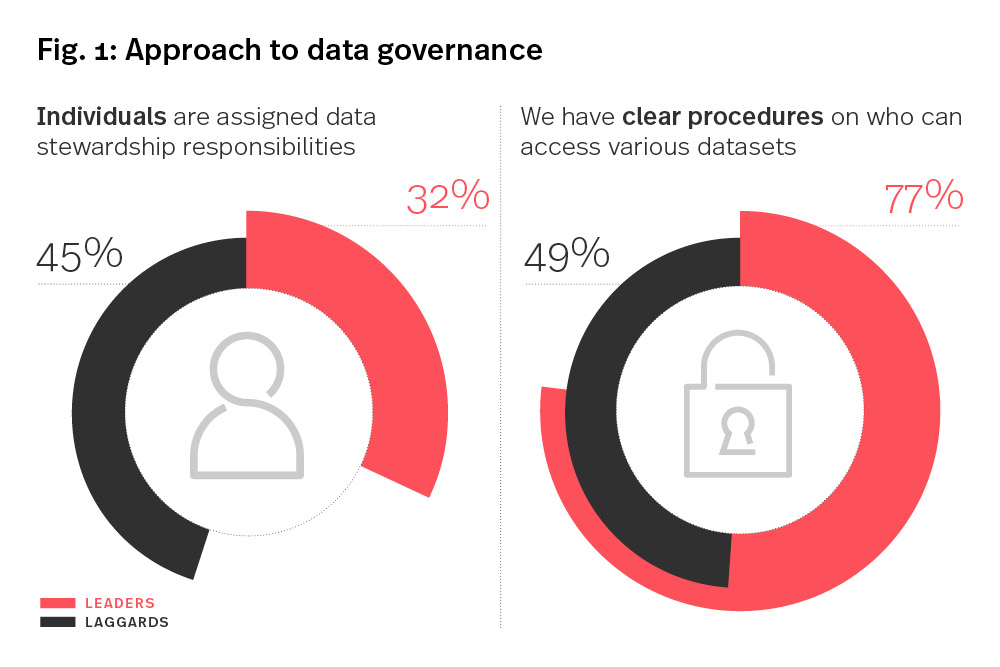
Organisations often think a data governance framework is just about the appointment of data stewards, who are tasked with enforcing data compliance across the organisation. Yet this is not enough to ensure the correct use of data. Data governance frameworks should also set clear procedures around who can access data and how it can be used. This is the approach most data leaders take. While they don’t overlook the need for data stewardship, they are much more likely than laggards to put a clear set of standards in place to define who can access different datasets (Fig. 1). This is critical to ensuring the dynamic use of data assets.
They feed systems with high-quality data
When it comes to data, what you get out reflects what you put in. If you feed your systems with poor-quality data, you’ll only gain poor-quality insights. Our research shows data leaders are eager to avoid this by creating clear rules around data entry. Overall, 51% say they have a data input governance framework that covers most types of data. This, for example, may stipulate how data is added and reviewed. It may also establish clear taxonomic guidelines. By contrast, laggards typically adopt an incomplete patchwork of measures that only relate to certain types of data.
You can’t use data well without strict governance. Part of this involves managing the rules for how data is created. A lot of the rest is about who owns it once it is created and how you manage conflicting information across multiple systems. – Will Sprunt, CIO, Deliveroo
They know who leads the charge
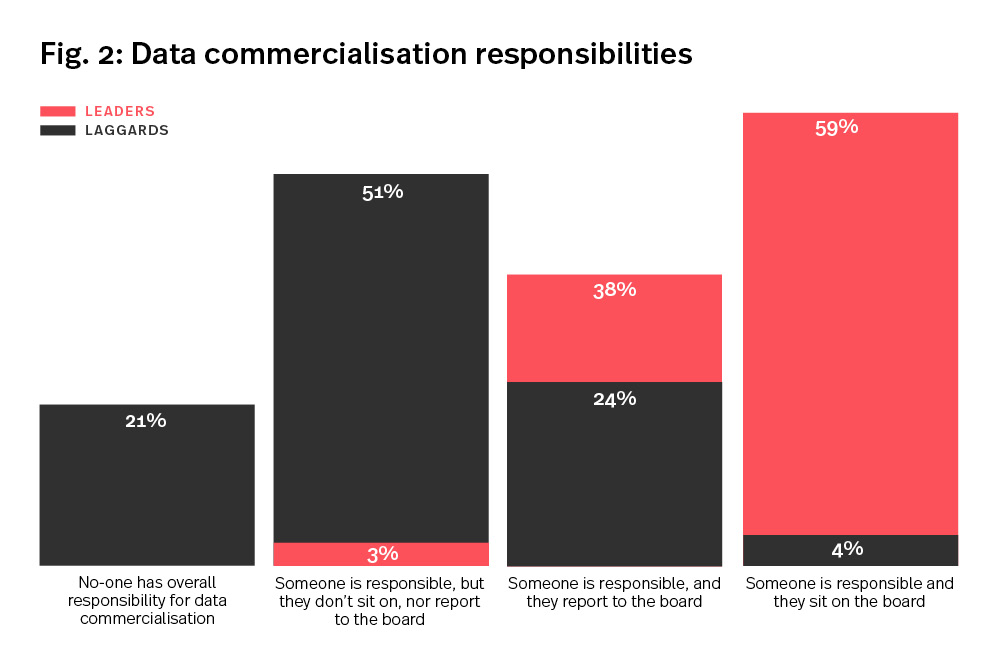
Accountability is a core tenet of good data governance. Someone within your organisation must retain overall responsibility for your data commercialisation efforts. Every organisation will have a different view on who should this be. The key is that the individual has a solid understanding of your data estate and the potential value within it. Every data leader we surveyed had already tasked someone to lead their data commercialisation efforts. By contrast, a worrying 21% of data laggards are yet to appoint anybody.
The most mature Telcos have a data champion such as a Chief Data Officer or Chief Digital and Data Officer. This isn’t necessarily a legal or compliance person nor a technology specialist. It is someone who is not only well-versed with data and technology but also commercially focused. Telcos that invested in that function have an awareness of what is feasible and what is not. – Amit Akhelikar, Chief Solutions Officer, Lynx Analytics
Their data leader has muscle
Data leaders are setting the right tone at the top when it comes to data governance. Our research shows that 59% have appointed an individual who retains overall responsibility for data and that, crucially, this individual sits on the board. This is the gold standard of data governance. It ensures data commercialisation strategies are created and implemented and underpinned by a culture of data-driven innovation. By contrast, just 4% of data laggards have adopted this approach (Fig. 2).
So, how do your data commercialisation efforts measure up?
Take our benchmarking tool to find out, and to access exclusive recommendations on how you can win The Big Data Race.
Return to The Big Data Race homepage to find more exclusive insights on data commercialisation.






.jpg?crop=300,495&format=webply&auto=webp)

.jpg?crop=300,495&format=webply&auto=webp)




_11zon.jpg?crop=300,495&format=webply&auto=webp)




.jpg?crop=300,495&format=webply&auto=webp)