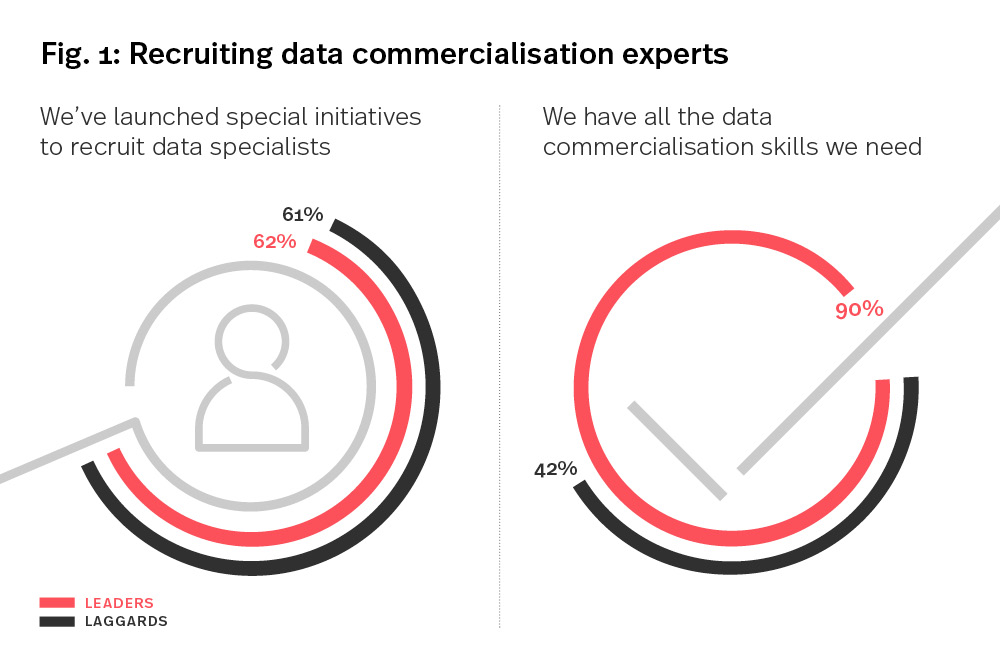
Data commercialisation may be a product of the digital age, but it’s important to remember that success will depend heavily on human ingenuity. Data leaders understand this. Our research shows 90% of these organisations now have all the skills they need to meet their data commercialisation objectives. By contrast, just 42% of laggards can say the same. How do data leaders attract the brightest data minds? How do they retain these highly sought-after workers? And what can we all learn from their success?
In the Big Data Race – as in any race – a strong start is critical. Data leaders have been quick to understand this. They were first to recognise the value of their data, and they were first to recruit the experts they needed to unleash its potential.
Our research reveals four key reasons why data leaders have been able to recruit the data specialists they need. Collectively, they offer important insights into how to attract – and keep hold of – the brightest data minds.
They offer the full package
Data leaders and laggards are working hard to find data commercialisation experts. Both sides have launched targeted initiatives to find the right people. The difference is that data leaders are significantly more successful (Fig. 1). Data leaders are big players – with a typical turnover of £1bn. That means they’re in a strong position to offer more attractive financial packages and, importantly, the most interesting data challenges.
You'll find a lot of people with the same job title as me, but the vast majority of them will report to a CIO or a CEO. They may be one or more steps removed from the board. – a Chief Data Officer
We also know that data leaders routinely make data a board priority. This is a big draw for data specialists, who want to know that their work will have true business impact. Likewise, when data commercialisation is at the heart of business strategy, it gives data specialists confidence that their career goals will be met. It sends a clear signal that they might too one day sit on the board or become part of the C-suite.
They’re a magnet for data scientists
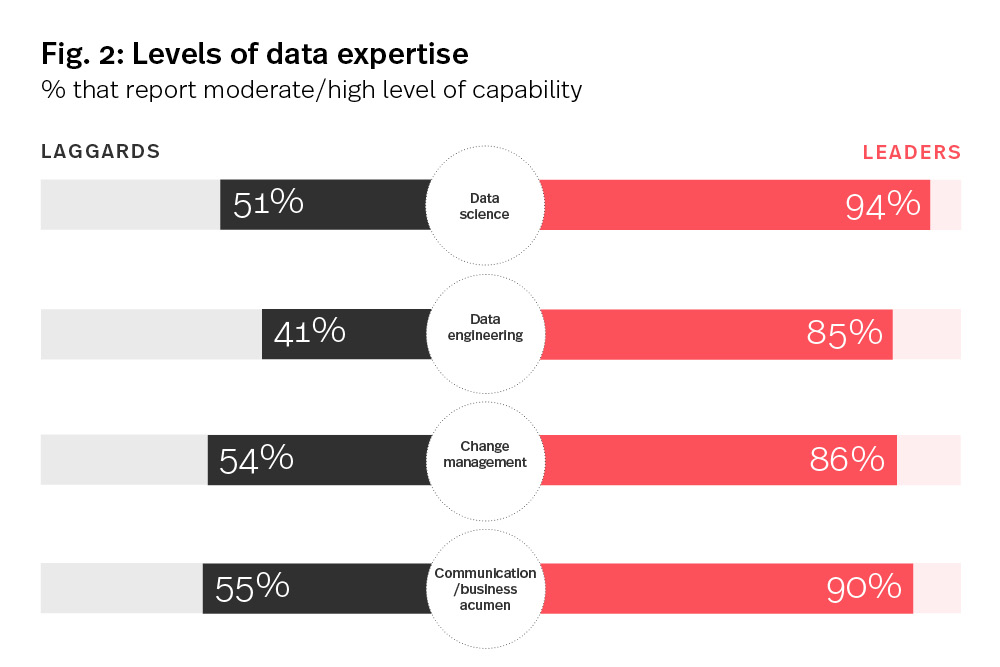
There is already a war for talent in the data space. This will only intensify. The race is on to attract and retain the brightest minds that can extract true business value from organisational data assets. Data science is one of the most critical and most sought-after skills. Data leaders have been extremely successful at attracting people with this expertise. They are nearly twice as likely to have attracted data scientists who can organise and synthesise data assets. Crucially, they’ve also managed to attract engineers to build the right analytics, infrastructure and warehousing solutions (Fig. 2).
They don’t just attract data scientists
Data leaders know that they can’t just rely on data scientists and engineers if they are to truly unleash value from their data. They also need people who can transform organisational processes, policies and cultures. Overall, 86% of data leaders say they have a high or moderate level of capability when it comes to change management expertise. For data laggards, this drops to just 54%. Similarly, data leaders have also managed to attract experts with strong communication skills. This is key. It helps executives to not only coordinate teams but also motivate them to take action (Fig. 2).
Rather than speaking loosely about data science skills, companies need to recruit people with good mathematical and statistical knowledge, people with data engineering and coding ability and people with good business acumen and business understanding. Data scientists rarely tick all three boxes. – Thomas Ridings, Analytics Engagement Manager at Intent HQ
They don’t always see data as ‘king’
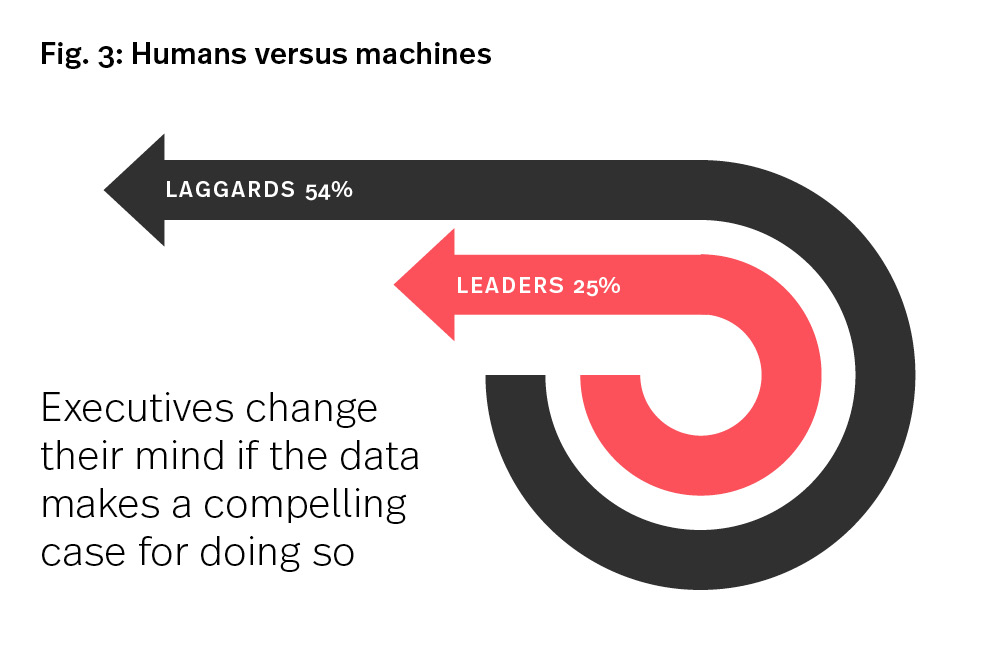
How much should executives rely on what the data shows? And what are the implications of blindly following the authority of an algorithm? These are big and novel questions. Executives are taking a cautious approach. They follow their human insight and are not unduly swayed by the data. This is particularly the case among data leaders. Executives at these organisations are less likely to change their minds if data makes a compelling case for doing so (Fig. 3). This could evidence healthy scrutiny of the data and application of experience. Equally, it could indicate that, as larger organisations, data leaders find it harder to change their agreed approach, even if the data suggests a different course of action. This could be a failing of corporate governance.
So, how do your data commercialisation efforts measure up?
Take our benchmarking tool to find out, and to access exclusive recommendations on how you can win The Big Data Race.
Return to The Big Data Race homepage to find more exclusive insights on data commercialisation.



.jpg?crop=300,495&format=webply&auto=webp)




_11zon.jpg?crop=300,495&format=webply&auto=webp)





.jpg?crop=300,495&format=webply&auto=webp)

_11zon.jpg?crop=300,495&format=webply&auto=webp)