The temporal scope of rules of the Damages Directive specified
On 22 June 2022, the European Court of Justice (ECJ) provided valuable clarification on the temporal scope of certain rules of the Damages Directive.
The Damages Directive aims to facilitate the compensation of damages suffered by direct competitors and direct or indirect purchasers before judiciary and administrative courts. On 22 June 2022, the European Court of Justice (ECJ) provided valuable clarification on the temporal scope of certain rules of the Damages Directive.
Background
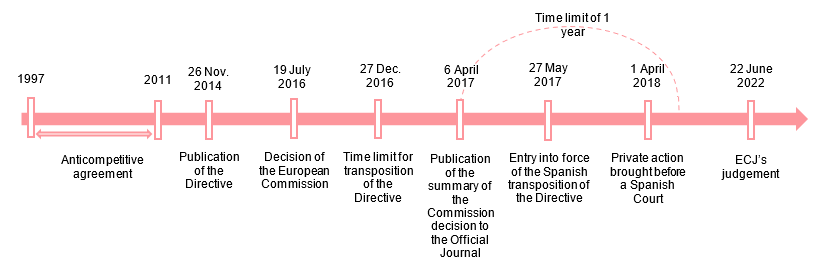
In a decision dated 19 July 2016, the European Commission fined truck manufacturers for colluding on the setting and the increase of prices of medium and heavy trucks and on the timing and the passing on of costs for the introduction of emission technologies required by EU legislation.
A company – which bought trucks to two perpetrators of the infringement – brought an action before a Spanish Court to seek compensation for the harm suffered as a result of the anticompetitive agreement. The Spanish Court decided to refer questions to the ECJ for a preliminary ruling.
Clarification by the ECJ
The question was whether (i) Article 10 of the Damages Directive on the time-barring of actions for damaging for infringement of competition law, (ii) Article 17(1) on quantification of harm resulting from such infringements and (iii) Article 17(2) on the presumption of the existence of that harm are applicable to an action for damages which, although relating to a cartel which ceased before the entry into force of that directive, was brought after the entry into force of the provisions transposing it into national law.
First, the ECJ ruled that such an action falls within the temporal scope, in so far as the time limit applicable to that action under the old rules did not expire before the time limit for transposition of the directive, the latter not having been transposed into Spanish law within that time limit. In this case, the old rules provided for a time limit of one year, starting from the date on which the claimant became aware of the facts giving rise to the cartel. The Court held that the time limit couldn’t run from the publication of the press release of the Commission’s decision because it did not contain the essential elements of the infringement with sufficient precision. The time limit ran therefore from the publication of the decision’s summary in the Official Journal in this case.
Further, the ECJ stated that Article 17(1) is a procedural provision which, in accordance with the Directive, can only apply to actions brought before a national court after 26 December 2014.
Finally, the ECJ held that Article 17(2) is a substantial provision and had to determine whether the situation at issue arose before the expiry of the time limit for transposition of that directive or whether it continued to produce effects after the expiry of that time limit. The ECJ stated that since the fact identified by the EU legislator as giving rise to a presumption of the existence of harm is the existence of a cartel, it is necessary to verify whether the date on which the cartel at issue ceased precedes the date of expiry of the time limit for transposing the Directive. In this case, the ECJ has stated that the infringement stopped before the time limit for transposing the Directive and thus can’t be applicable to this claim.
If you’re interested to get more information regarding the private enforcement topic, read more here.














.jpg?crop=300,495&format=webply&auto=webp)
.jpg?crop=300,495&format=webply&auto=webp)