Mind the tax gap
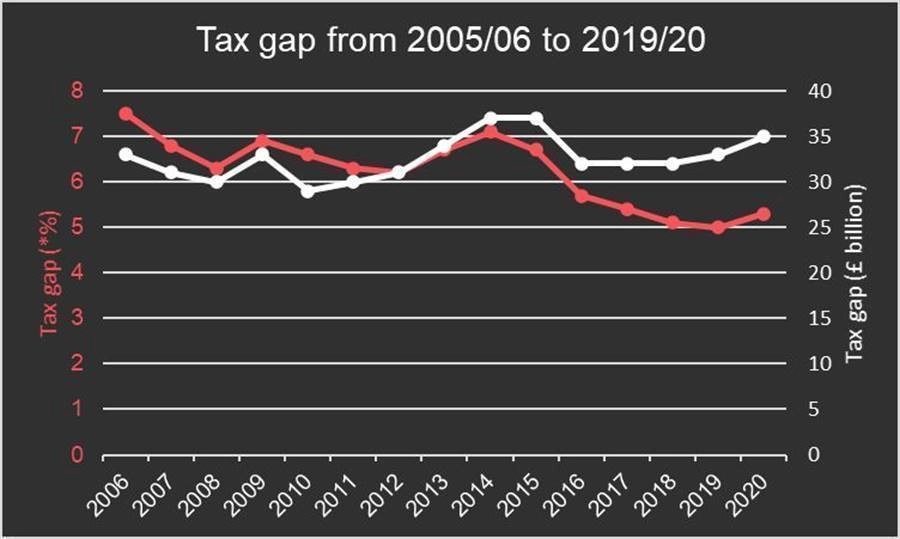
HMRC has published figures showing the tax gap in 2019/20 is estimated at £35bn.
HMRC has recently published its annual report, Measuring tax gaps. The report provides data from 2005/06 to 2019/20 on the amount of tax that HMRC expected to collect versus the amount actually collected. Our view is that it augurs significantly increased tax compliance activity, particularly for large business.
Why does it matter?
The tax gap is (in HMRC’s view) all tax that should be paid, but is lost - to error, tax avoidance, criminality, or differences in legal interpretation. The political case for collecting this tax is straightforward and uncontroversial: it is tax that individuals and businesses "owe". A large tax gap might be taken as evidence that revenue should be raised by increasing enforcement efforts, as opposed to imposing new taxes or changing rates.
The data show that such an approach hasn't really worked. The raw amount of the tax gap is barely changed from 15 years ago - £35 billion as opposed to £33 billion. The percentage gap seems basically stuck, having gone from 7-and-a-bit to 5-and-a-bit.
What happens next?
There is plenty of potential for a requirement to increase revenue. The UK budget is now under pressure from two directions.
- The first is the cost of servicing debt. Chancellor Sunak has is understood to be concerned by the prospect that a 1% rise in interest rates would increase the cost of government borrowing by £25 billion per annum. There is an incentive for the government to reduce the level of the UK's debt - which currently stands at an amount roughly equivalent to around 100% of the UK’s GDP.
- The second pressure comes from likely increases in spending. The government’s 'levelling up' agenda will come at a significant cost. In the aftermath of Covid-19, there are also likely to be calls from across the economy for an increase in governmental support.
To strike a balance between these positions, the UK’s autumn budget is likely to see the introduction of further ‘fiscal rules’ requiring the government not to borrow to fund day-to-day expenditure by 2024-25. This approach was foreshadowed by the introduction of the 1.25% Health and Care Levy (on a basis similar to, but slightly broader than, National Insurance Contributions (NICs)) to fund increased spending on the National Health Service and social care.
Where does the tax gap come in?
It would be politically uncomfortable for the government to increase the rate of any tax, or to introduce new taxes. The Conservative Party manifesto promised that there would be no increase in the rates of income tax, NICs or VAT (the three largest taxes – collectively worth around 57% of the government’s income in each year).1 That manifesto commitment has by the Prime Minister’s own acknowledgement been broken. Corporation tax increases have already been announced. Other taxes make a relatively modest contribution to the UK tax take and it would be politically controversial to increase their rates. For example, Stamp Duty Land Tax is deeply unpopular for its perceived chilling effect on the property market, but might raise as little as £12 billion in 2021-22.
The government will want to raise more revenue, especially if it is to comply with the expected new fiscal rules, but there would be a serious political cost to taking any of the more straightforward options. Treasury ministers, therefore, may well ask themselves why HMRC isn’t doing more to collect the £35 billion or so represented by the tax gap.
What might the government do?
VAT and income taxes
The two largest components of the tax gap are VAT and income tax.
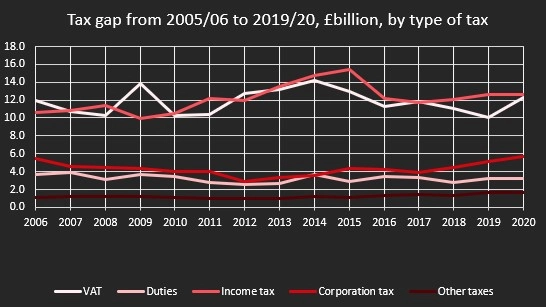
From a VAT perspective, the tax gap is estimated to be £12.3 billion, or 8.4%. This is higher than the average tax gap and so VAT collection is likely to see continued attention and pressure, despite the fact that it has fallen from 14.1% in 2005/06 (though there is an increase from 7% in 2018/19).
There will no doubt be a focus on VAT avoidance as a component of the VAT gap. However, VAT avoidance was estimated at £0.1 billion in 2019/20 or just 0.0123% of the total VAT gap. HMRC is likely to have to be quite creative if it is to address VAT avoidance, and the rewards for doing so are low. VAT is therefore not likely to be seen as low hanging fruit, the high tax gap notwithstanding.
Income tax is likely to be a harder area in which to improve compliance. There is a significant tax gap – over 20% – for self-assessed income tax paid by business taxpayers. HMRC’s challenges in this area are likely to be driven by incomplete access to data.
Large businesses
Large businesses are likely to feel HMRC’s attention particularly acutely. They have well-established reporting routines, and tend to have access to advisors to whom HMRC can talk. We would expect HMRC to look quite hard at how they can recover tax from large businesses.
Large businesses don't actually have a particularly large tax gap - £6 billion, compared to over £20 billion for SMEs - but they are much easier for HMRC to deal with. While the data does not make it clear, it would seem reasonable to assume that the tax gap for large businesses is driven less by criminality and evasion than by their simply disagreeing with HMRC and taking a filing position based not on HMRC’s guidance but on legal advice. Hence, for example, the Uncertain Tax Treatment notification regime, which has been limited to large businesses and is the subject of our article here. In practice, large businesses are much easier for HMRC to deal with, but to get even more tax out of large businesses HMRC will need to push even harder. Hence large businesses are likely to feel the squeeze most.
Increased compliance on the horizon
The government has an obvious source of untapped revenue in the form of a persistent tax gap. Under such circumstances, we would expect to see a continuation of the trend towards information gathering and compliance checks we have seen in recent years. We expect the burden to fall most heavily on large businesses, as they are the simplest taxpayers for HMRC to check. All this adds up to increased compliance and reporting work, and much more frequent intervention by HMRC.
Other sources of information on the tax gap include the following:
1 Where does the government get its money? | IFS Taxlab accessed 24 September 2021

.jpg?crop=300,495&format=webply&auto=webp)


.jpg?crop=300,495&format=webply&auto=webp)
.jpg?crop=300,495&format=webply&auto=webp)






.jpg?crop=300,495&format=webply&auto=webp)



.jpg?crop=300,495&format=webply&auto=webp)


.jpg?crop=300,495&format=webply&auto=webp)