FinTech: Expert Group publishes Final Report to European Commission
On 13 December 2019, the Expert Group on Regulatory Obstacles to Financial Innovation (ROFIEG), set up by the European Commission (Commission) in June 2018, published its recommendations on how to create an accommodative framework for technology-enabled provision of financial services.
In March 2018, the Commission published a FinTech Action Plan as part of its efforts to build a Capital Markets Union and a Digital Single Market. In accordance with that plan, the Commission established an Expert Group to review the application and suitability of the European legal and regulatory framework to FinTech in order to identify issues that may impede the growth of FinTech in the EU. The Final Report sets out the Expert Group’s findings on these and other matters.
Benefits
The Expert Group believes that an accommodative framework for FinTech in the EU could provide four kinds of benefits:
- provision of financial services at lower costs;
- a broader range of products and services;
- improved access to financial products and services; and
- more effective regulation and compliance.
The Expert Group identifies an inadequate regulatory framework as a key obstacle to realising these benefits. The Expert Group agrees that harmonising and clarifying regulatory and supervisory measures will provide an effective tool to support the scaling up of FinTech across the EU.
Risks and safeguards
The Expert Group recognises that many of the risks associated with the use of FinTech products and services are similar to risks associated with the use of traditional products and services. However, the Expert Group identifies some new risks arising from the growing use of artificial intelligence (AI) and distributed ledger technologies (DLT).
International landscape
The Expert Group acknowledges the need for the EU to remain technologically competitive internationally, drawing unfavourable comparisons with the US and China. At the same time, the Expert Group believes the EU should maintain its role as a key setter of standards both to promote European values such as data privacy and fair competition and to maintain its sovereignty. The Final Report makes clear that increased regulatory harmony across Member States is necessary for the EU to realise its ambition of becoming a global FinTech hub.
Approach
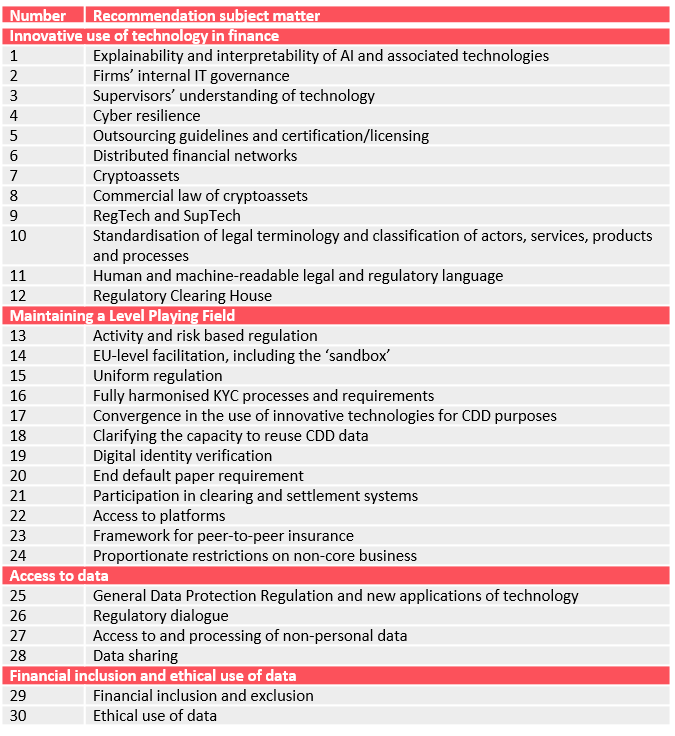
The Final Report sets out 30 recommendations. Broadly speaking, these recommendations are based on common regulatory and supervisory themes and are not specific to any technology, business model or product. However, this approach does break down in places as the Expert Group addresses novel issues raised by emerging technologies.
Key findings
The Final Report including the full text of all 30 recommendations can be found here.
Each recommendation addresses one of four key objectives:
- addressing new and changed risks caused by the use of innovative technologies, such as AI and DLT;
- removing regulatory fragmentation and ensuring a level playing field between incumbents and new market entrants (such as start-ups and BigTech);
- reconciling the regulation of personal and non-personal data with the opportunities and risks offered by FinTech; and
- promoting financial inclusion and the ethical use of data.
Given the number and breadth of its recommendations, the Expert Group has chosen to highlight those it believes should take priority:
- the ability to explain and interpret technology, especially AI, as measures to protect consumers and businesses and facilitate supervision, or to meet supervisory expectations (Recommendation 1);
- the creation of a regulatory framework built on the principle that activities that create the same risks should be governed by the same rules, with a view to ensuring adequate regulation and supervision and maintaining a level playing field (Recommendation 13);
- the ending of regulatory fragmentation, especially in the area of customer due diligence (CDD)/know your customer (KYC), as an important step towards creating a level playing field (Recommendations 15-17);
- preventing unfair treatment of competing downstream services by large, vertically integrated platforms, in order to strengthen innovation and maintain consumer choices (Recommendation 22); and
- strengthening the framework for access to, processing and sharing of data, in order to promote innovation and competition and establish a level playing field (Recommendations 27 and 28).
The Expert Group stresses that the aims informing its recommendations are best pursued by regulation that is technology neutral. The Expert Group also believes that international cooperation in setting relevant standards, ideally leading to interoperability, is crucial in this exercise.
Overview of recommendations
Next steps
While the Commission’s policy response to the Final Report remains to be seen, the direction of travel appears clear: President Ursula von der Leyen has asked Valdis Dombrovskis, Executive Vice-President for An Economy that Works for People, to “put forward a FinTech Strategy to support new digital technologies in our financial system”. She has also recently stated that "We have to make our single market fit for the digital age, we need to make the most of artificial intelligence and big data, we have to improve on cybersecurity and we have to work hard for our technological sovereignty."




_11zon.jpg?crop=300,495&format=webply&auto=webp)
.jpg?crop=300,495&format=webply&auto=webp)

.jpg?crop=300,495&format=webply&auto=webp)
.jpg?crop=300,495&format=webply&auto=webp)


.jpg?crop=300,495&format=webply&auto=webp)