Introduction
This article sets out an overview of the European Union (EU) Foreign Subsidies Regulation (FSR) and the challenges the FSR presents for Chinese companies engaged in mergers and acquisitions (M&A) and in public procurement processes in the EU. The article offers practical pointers on how Chinese companies can navigate and ensure they comply with the FSR's requirements.
Overview of the FSR
The European Union (EU) Foreign Subsidies Regulation (FSR) represents a significant development in the EU's approach to maintaining fair competition within its internal market. Officially adopted in July 2023, the regulation addresses concerns that foreign subsidies can distort competition, particularly when they enable foreign companies to outbid or outcompete EU firms in mergers, acquisitions, and public procurement processes.
Key Features of the EU Foreign Subsidies Regulation
1. Scope and Objectives: The FSR targets subsidies provided by non-EU governments to companies operating within the EU. Its primary objective is to prevent market distortions that arise from such subsidies, ensuring a level playing field for all businesses within the EU. The European Commission (EC) is the sole authority for enforcing the FSR.
2. Definition of Foreign Subsidies: The FSR defines foreign subsidies broadly, encompassing any foreign financial contribution from a non-EU country that confers a benefit on a company engaging in economic activity within the EU. This includes direct financial transfers, tax exemptions, and other forms of support. A non-EU government body or local authority may provide a subsidiary. Private companies may also indirectly provide subsidies where their actions are attributable to a non-EU government. An example of an indirect subsidy provided by a private company could be a case where the government of a non-EU country has substantial control over a major steel manufacturing company, even though the company is technically private. The non-EU government might direct this company to sell steel at below-market prices to international buyers, effectively subsidising the cost of steel exports. The EC could deem this action an indirect subsidy because in this case the company's pricing strategy was influenced by the non-EU government's objectives, such as boosting exports or gaining a competitive advantage in international markets. In this case, the private company's actions are attributable to the non-EU government because the government exerts control or influence over the company's decisions, aligning them with the government’s own national policy goals.
3. Thresholds and Notification Requirements: Companies must notify the EC of foreign subsidies if they exceed certain thresholds. For mergers and acquisitions, the threshold is set at €500 million, while for public procurement, it is €250 million (or €125 million if divided into lots) and where the bidder cumulatively received €4 million or more in foreign financial contributions in the last three years. Notifications are mandatory, and failure to comply can result in penalties such as fines, repayment of subsidies or even suspension or prohibition of the transaction.
4. Ex Officio Investigations: In addition to the mandatory notification requirements, the FSR includes provisions for ex officio investigations. This element allows the EC to initiate investigations independently into foreign subsidies that may distort the EU market, even if they fall below the established notification thresholds or if the companies involved have not voluntarily disclosed such subsidies to the EC. To date, the EC has launched three ex officio investigations all of which are addressed at Chinese entities.
5. Investigation and Enforcement: The EC has the authority to investigate foreign subsidies that may distort the EU market. It can impose measures such as fines, repayment of subsidies, or even block transactions if the EC finds such subsidies significantly distort competition. In public procurement processes, which exceed the notification thresholds, a contract cannot be awarded until the EC has cleared relevant bidders. A violation of these rules can lead to significant fines, up to 10% of the total global annual turnover of the company concerned. In addition, the EC can prohibit the implementation of a transaction or annul the award of a public contract to a bidder if it finds that the relevant party benefited from subsidies that affected the transaction or its bid.
6. Remedial Measures: If a foreign subsidy is deemed distortive, the EC can impose various remedial measures. These may include structural or behavioural remedies, such as ring-fencing a supplier’s European subsidiary to prevent cross-subsidisation from the parent, divestment of assets or restrictions on market conduct.
7. Interplay with Existing EU Regulations: The FSR complements existing EU competition laws, such as antitrust and merger control regulations, by specifically addressing the impact of foreign subsidies.
Operational Mechanism
The EU Foreign Subsidies Regulation operates through a structured process involving notification, investigation, and enforcement, with a significant emphasis on both mandatory notifications and ex officio investigations:
Notification: Companies must proactively disclose foreign subsidies that meet the specified thresholds. This transparency is crucial for the EC to assess potential market distortions. Notifications are mandatory for mergers and acquisitions exceeding €500 million and public procurement processes over €250 million (or €125 million if divided into lots) and where the bidder received €4 million or more in foreign financial contributions in the last three years.
Ex Officio Investigations: Beyond the notification system, the EC can initiate ex officio investigations into foreign subsidies that may distort the EU market. This mechanism allows the EC to independently investigate subsidies, even if they fall below the notification thresholds or have not been disclosed. Ex officio investigations may be triggered by market intelligence, complaints, or other indications of potential distortive effects. Relevant are all financial contributions of up to 10 years (but no earlier than 12 July 2018) that distort the internal market after 12 July 2023. Typically, there is no distortion if the aggregate amount of any subsidies provided within the prior 3 years is less than €4 million or if the conditions for de minimis subsidies are met.
Investigation: Upon notification or initiation of an ex officio investigation, the EC evaluates whether the subsidy distorts competition. This involves a detailed analysis of the subsidy’s nature, amount, and impact on the market. When assessing whether a foreign subsidy distorts competition in the common market, the EC balances the negative effects of the relevant subsidies against the positive effects in terms of the development of the subsidized economic activity. Examples of how the EC might consider subsidies are set out below:
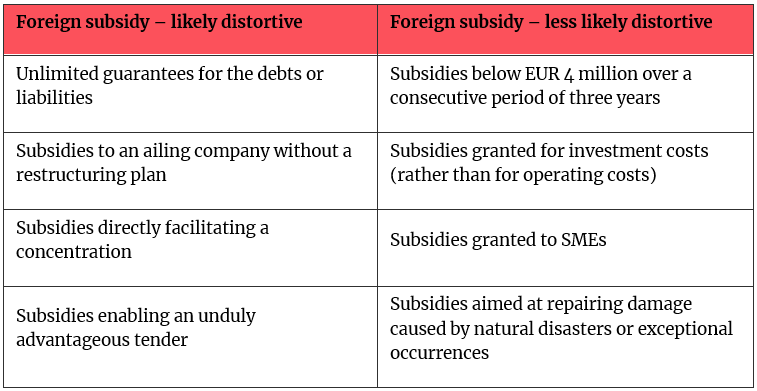
Enforcement: If a subsidy is found to be distortive, the EC can enforce corrective measures to neutralise its impact, ensuring fair competition within the EU. Remedial measures may include fines, repayment of subsidies, or structural and behavioural remedies such as requiring the ring fencing of a supplier’s European subsidiary to prevent cross-subsidisation from the parent.
Recent Ex Officio Investigation: Chinese Wind Turbines
A recent example of the ex officio element in action is the EC's investigation into subsidies provided to Chinese wind turbine manufacturers. This investigation was initiated due to concerns that these subsidies were enabling Chinese companies to undercut EU competitors, potentially distorting the market for wind energy technology.
Details of the Investigation
- Trigger: The investigation was prompted by complaints from EU wind turbine manufacturers and market analysis indicating that Chinese companies were benefiting from state-backed financial support.
- Scope: The investigation focuses on the nature and extent of subsidies provided to Chinese wind turbine manufacturers, assessing their impact on competition within the EU market. The Commission is particularly interested in whether these subsidies allow Chinese companies to offer lower prices, thereby gaining an unfair competitive advantage.
- Outcome: While the investigation is ongoing, it highlights the EC's pro-active approach in using ex officio powers to address potential market distortions. Further examples of the EC’s use of the FSR include investigations following FSR notifications of tenders submitted by Chinese companies in EU public procurements related to (i) electric trains in Bulgaria (this investigation closed when the targeted company withdrew its tender), and (ii) solar photovoltaic park in Romania.
Challenges for Chinese companies
The regulation poses several challenges for Chinese companies:
- Increased Regulatory Scrutiny: Chinese firms must disclose subsidies exceeding these thresholds, which may lead to investigations and possible remedial measures if deemed distortive.
- Operational Adjustments: Companies may need to adjust their business strategies to align with EU standards, potentially affecting investment decisions and market entry strategies.
- Competitive Disadvantages: The regulation could result in competitive disadvantages for Chinese companies if subsidies are found to distort competition, leading to fines or restrictions. It may also lead to EU companies avoiding awarding projects to Chinese companies due to the uncertainty of what measures may be adopted by the EC and the impact that can have on the projects ability to secure financing.
By understanding these thresholds and their implications, Chinese companies can better navigate the regulatory landscape and mitigate potential risks associated with the EU Foreign Subsidies Regulation.
Practical Tips for Chinese Companies
To navigate the complexities of the EU Foreign Subsidies Regulation, Chinese companies should consider the following strategies:
1. Enhanced Compliance Measures: Establish robust compliance frameworks to ensure accurate reporting of subsidies and adherence to EU regulations.
2. Strategic Partnerships: Collaborate with local EU entities to mitigate risks associated with foreign subsidies and enhance market integration.
3. Legal Consultation: Engage with legal experts familiar with EU regulations to proactively address potential issues and optimise business operations within the EU.
4. Risk Assessment: Conduct thorough risk assessments to identify potential impacts of the FSR on business activities and develop contingency plans.
5. Monitoring: Actively monitor EC investigations in relevant sector and measures that the company may have benefited from.
By adopting these strategies, Chinese companies can better position themselves to thrive in the EU market while complying with the new regulatory landscape.