Regulatory Initial Margin: the time for the buy-side to act is now
A summary of the challenges to be faced by buy-side firms with respect to regulatory initial margin.
Background
The mandatory initial margin (IM) requirements for uncleared OTC derivatives is the final major piece of the UK EMIR*/EMIR jigsaw that has yet to be completed.
Fewer buy-side firms were caught by the earlier Phases 1-5 of the IM requirements. However, as the compliance threshold for the Phase 6 (commencing from September 2022) falls to €8bn, the IM requirements are expected to apply to a much larger number of buy-side firms. ISDA estimated that as many as 775 entities will be caught in Phase 6 – which is well over double the number of entities caught in Phase 5 and is likely to include a much larger number of buy-side firms.
Buy-side firms that are caught by the IM requirements will need wholly new arrangements with their dealer counterparties and custodians in order to comply with the IM requirements. In addition, those buy-side firms that have existing non-regulatory-compliant segregated IM or Independent Amount structures in place will need to revisit such arrangements in order to bring them into compliance with the IM requirements.
Firms falling in to Phase 6 should be grasping the nettle as a priority and, if not already in progress, beginning their process to implement the IM requirements now.
Simmons & Simmons acted for the first buy-side firm caught by the IM requirements (in Phase 3) and many of the buy-side firms caught in Phases 4 and 5. Through the depth of this experience, we offer an unparalleled solution to firms looking for a trusted adviser to assist with their preparations for Phase 6.
*We refer to the substantive replication of the relevant provisions of EMIR into UK domestic legislation following the end of the Brexit transition as UK EMIR.
To whom and when do the obligations apply?
Under the UK and EU margin rules, the IM requirements will apply, subject to the thresholds and phase-in periods set out below, where both parties to an uncleared OTC derivative fall into one of the following classifications:
- financial counterparties (FCs) (including UCITS, AIFs with an authorised UK/EU AIFM, UK/EU AIFs (irrespective of whether they have an authorised UK/EU AIFM) and most UK/EU pension schemes);
- non-financial counterparties above the UK EMIR/EMIR clearing threshold (NFC+s); and
- if they are facing an FC or an NFC+, third country entities (TCEs) that would be an FC or an NFC+ if established in the UK/EU.
The UK EMIR/EMIR IM requirements can also apply where each party is a TCE that would be an FC or NFC+ if established in the UK/EU and there is a “direct, substantial and foreseeable effect” in the UK/EU.
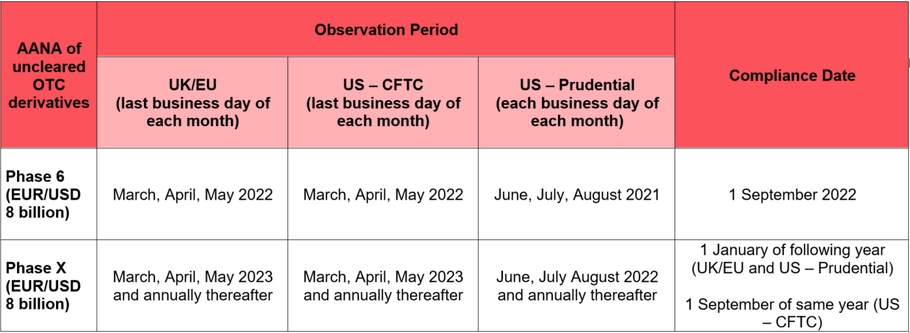
The table below sets out the remaining phase-in dates under UK, EU and US rules and the average aggregate notional amount (AANA) thresholds which apply to each phased-in compliance date. The AANA threshold must be breached by both counterparties in order for the IM requirements to apply.
However, since the major dealers will have already breached the AANA thresholds for one of the earlier Phases 1 to 4, as a practical matter when facing one of those dealers, the AANA determination for Phase 6 needs to be performed primarily by buy-side firms.
In the US, there are additional and separate margin rules published by the SEC for non-bank “security-based swap dealers” which are scheduled to be effective from 1 November 2021. The SEC margin rules have a number of key differences from the IM requirements for uncleared OTC derivatives – e.g. under the SEC margin rules a dealer can hold collateral itself, but must do so in a segregated account which can include the assets of other customers. While we understand that the SEC margin rules should generally not present a substantial change for buy-side firms – they will need to fully consider the impact of such rules should their counterparty be a security-based swap dealer that is subject to the SEC margin rules.
What are the key UK EMIR/EMIR IM requirements?
Many of the requirements imposed by the UK EMIR/EMIR IM requirements will be new for buy-side firms and will therefore introduce fresh legal and operational challenges. The most significant of these is that buy-side firms will be required to both post IM to dealers and to receive IM from dealers. Such IM posting/receiving must be performed on a gross basis so cannot be offset against each other and the IM that is posted and received must be segregated from the insolvency risk of the party that is receiving the IM. Onboarding with these custodians (not just for their posting leg but also for the dealer posting leg as well), agreeing Eligible Collateral (IM) Schedules and calculating the margin methodology pursuant to ISDA SIMM will also present fresh challenges for buy-side firms.
In addition, the UK EMIR/EMIR IM requirements prescribe both the frequency at which IM must be calculated (i.e. upon the occurrence of certain events and at least every 10 business days) and the methodology that must be used (eg ISDA SIMM or using the “grid” percentages). Although IM is subject to the same eligibility and haircut requirements as the variation margin (VM) requirements introduced in early 2017, IM is also subject to concentration limits in respect of the assets that may be provided as collateral.
Buy-side firms that are directly subject to UK EMIR/EMIR will also be required to undertake further monitoring and assessment of their margining arrangements. Such buy-side firms will have to perform validation, back-testing and auditing assessments on any IM model that they use. In addition, they will have to obtain an independent legal review/opinion of both the compliance of the segregation arrangements and the enforceability of the new IM documentation. We have developed a cost effective and user-friendly product which enables buy-side firms to meet their obligation to complete this independent legal review, the Simmons “Netting + Collateral reviewer” (available here).
While UK EMIR is a substantive replication of the relevant provisions of EMIR into UK domestic legislation following the end of the Brexit transition, there are some differences between UK EMIR and EMIR and, while as much of the preparation for the IM requirements has been with EMIR in mind, additional care needs to be taken for firms to which UK EMIR applies so as to ensure that they are fully compliant with the IM requirements as set out under UK EMIR.
What legal documentation is required?
In contrast to the VM requirements, the legal documentation upgrade necessary for compliance with the IM requirements is both significant in number and challenging in complexity. In particular, while the VM requirements led to minor technical uplifts to the documentation, establishing effective and enforceable security and segregation arrangements, often on a cross-border basis, is inherently more involved from a legal perspective.
The diagram below sets out the documentation required between a buy-side firm and a dealer. As can be seen, while compliance with the VM requirements were met with a single upgrade to an existing Credit Support Annex, compliance with the IM requirements could mean up to five additional agreements per dealer relationship, including potential onboarding with unfamiliar triparty custodians such as Euroclear and/or Clearstream.

When should new documentation be put in place?
Dealers and the market in general now have more implementation experience than they had from Phases 1-4 (which was largely confined to implementing in the inter-dealer market) because of the number of firms that were caught by Phase 5. However, due to the sheer number of firms that are expected to be subject to Phase 6, the market expects it to be a significant undertaking to ensure that such firms are compliant by the compliance date. The immediate issues that we anticipate are (1) determining whether firms will be caught by Phase 6 (noting the additional complexities for funds with multiple independent investment managers and funds that take seed capital from other funds), and (2) the bottleneck that is expected as dealers and custodians are squeezed for time and capacity by the greater number of firms caught by Phase 6 than in the previous Phases.
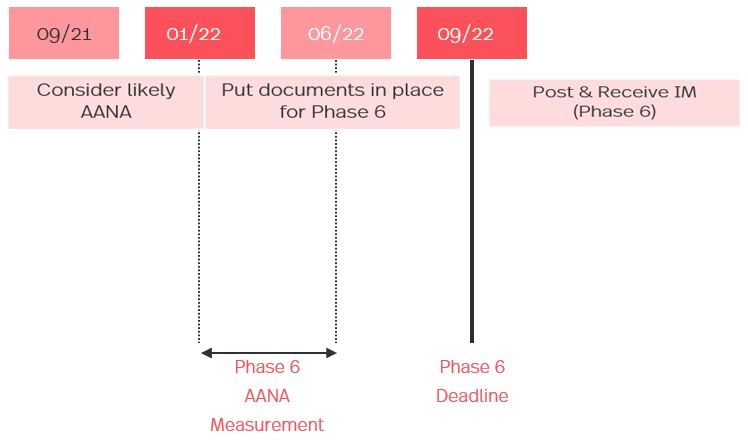
Such challenges are compounded by the fact that buy-side firms will not know with certainty whether they will be caught by Phase 6 until the relevant period for measuring AANA in 2022. The three-month window under UK EMIR/EMIR between AANA measurement and the start date of IM requirements will not provide sufficient time to put the necessary documentation in place, so parties will need to make an informed decision in advance of these measurement windows whether they are likely to be subject to the IM requirements. Buy-side firms wishing to influence terms and negotiate substantively to reach the best outcome for their funds or clients would therefore be well-advised to consider moving earlier to put regulatory-compliant arrangements in place
The final crucial factor to be considered is the timing deadlines that will be imposed by the custodians, which will be some months in advance of the relevant September start date. The diagram below sets out a suggested approximate timeline to which buy-side firms caught by the UK EMIR/EMIR requirements should consider working.
Phase 6 implementation timeline
Contact details
If you would like further information or specific advice, please see the contacts on the right-hand side.

_11zon.jpg?crop=300,495&format=webply&auto=webp)
_11zon.jpg?crop=300,495&format=webply&auto=webp)




_11zon.jpg?crop=300,495&format=webply&auto=webp)



.jpg?crop=300,495&format=webply&auto=webp)





.jpg?crop=300,495&format=webply&auto=webp)
.jpg?crop=300,495&format=webply&auto=webp)
.jpg?crop=300,495&format=webply&auto=webp)