PRC Private Fund Programs – QFLP/PFM/QDLP
An overview of the QDLP/QDIE programs, the QFLP programs, and the WFOE PFM programs to understand the PRC private fund market.
Echoing with the PRC regulator's continuing efforts to open up the domestic financial services industry to foreign investors and asset management institutions, we have witnessed and facilitated, over the years, the development of various private fund programs that would enable global asset managers to gain access to the onshore private fund market.
We will discuss the three most commonly used private fund programs, namely, the QDLP/QDIE programs, the QFLP programs, and the WFOE PFM programs (collectively referred to as the PRC Private Fund Programs).
An Overview of Various PRC Private Fund Programs
Onshore fundraising and overseas investment - QDLP/QDIE
Qualified Domestic Investment Partnership (QDLP) and Qualified Domestic Investment Entity (QDIE) are pilot programs developed by Chinese local authorities (i.e. Beijing, Shanghai, Tianjin, Shenzhen etc.). They allow foreign asset managers to raise RMB from wealthy and institutional investors in China for the purpose of overseas investment, through a Chinese feeder product.
The detailed investment scope varies among the QDLP programs launched in different locations, but most of the QDLP programs permit investment into overseas public markets either directly or through offshore master funds. In practice, QDLP managers raise capital through a Chinese QDLP feeder fund and then feed it into their overseas master fund.
The QDIE program (launched by the Shenzhen government) is a similar program but with a broader scope for the overseas investment.
Updates with respect to the recent development of the QDLP pilot program can be read here:
Onshore and offshore fundraising and investment into the onshore private equity market - QFLP
Qualified Foreign Limited Partnership (QFLP) is a pilot program developed by various local authorities (e.g. Tianjin, Beijing and Shanghai).
The QFLP program was envisaged to grant foreign investors access to China's domestic private equity market. The QFLP program provides more favorable treatment to foreign private equity fund managers and institutional investors with respect to FOREX settlement. Under the QFLP program, a wholly foreign-owned enterprise (WFOE) or a Sino-foreign joint venture established by a foreign private equity fund manager will raise a fund in the form of a partnership and invest domestically.
Onshore fundraising and investment into the onshore securities market - WFOE PFM
In 2016, the Asset Management Association of China (AMAC) unveiled new rules allowing WFOEs to engage in private securities investment fund management business.
Under the private fund management (PFM) program, a foreign asset manager is allowed to establish a WFOE or a joint venture which serves as the private fund manager entity. The private fund manager can then raise an open-ended fund targeting at PRC qualified investors. The manager and the custodian are the de facto co-trustees of the private fund.
A private securities investment fund can invest in securities (usually referring to those more liquid type in China) issued in China, including stocks, bonds, fund units and other securities and derivatives recognised by the China Securities Regulatory Commission (CSRC).
Private securities investment funds may not invest in securities issued outside of China except that, they are allowed to trade Hong Kong stocks through the Stock Connect programs and, in the future, they may be allowed to participate through the Qualified Domestic Institutional Investors (QDII) qualification and quota.
Fund managers
Eligibility requirements
All three PRC Private Fund Programs impose certain eligibility requirements on the applicants (the onshore WFOE manager).
For instance, the Shanghai QDLP programs require the foreign shareholder or affiliate of the foreign shareholder of the applicants to be (i) an institution that practise fund management in the offshore market with a sound record; (ii) approved by the foreign regulators to practise asset management business; (iii) with a sound governance structure, comprehensive internal control systems, and good business behaviors; (iv) not having been subject to any major sanctions by regulators or judicial authorities in the past three years, and not under any major investigations by any regulators.
The WFOE PFM programs require the direct foreign shareholders of the applicants to be financial institutions authorised or approved by the financial regulatory authorities of its home jurisdiction. Securities regulators in the home country or region of the foreign shareholders shall have already signed a Memorandum of Understanding on Regulatory Cooperation with the CSRC or other regulators recognised by the CSRC. Further, the WFOE and its foreign shareholders shall not have been subject to any major sanctions by regulators or judicial authorities in the past three years.
The Shanghai QFLP programs require the foreign shareholder or affiliate of the foreign shareholder of the applicants to be one of the following: foreign sovereign funds, pension funds, endowments, charitable funds, investment funds (FoF), insurance companies, banks, securities companies, and other overseas institutional investors recognised by the local authority that (i) have a self-owned asset scale of not less than US$500 million or an AUM no less than US$1 billion; (ii) have not been subject to any major sanctions by regulators or judicial authorities in the past two years; (iii) have more than five years of relevant investment experience; and (iv) satisfy other conditions required by the joint committee. Some of the requirements such as the one on AUM is no longer strictly enforced in practice.
Incorporation/pre-approval
All three PRC Private Fund Programs require the incorporation of an investment entity in China as a private fund manager. It also requires a vetting of the applicant's business plan and background of the applicant's parent group by a joint conference consisting of various relevant local authorities. It takes 2-4 months in average to complete such pre-approval process and incorporate the entity.
AMAC registration (i.e. "licensing") of the private fund manager
The activities which will be performed by the foreign managers in China, such as promotion and marketing and portfolio management, are regulated in China, and thus a registration with AMAC as a private fund manager is required.
During the registration stage, the AMAC needs to make sure that an applicant has established various internal control policies, and has met, among others, the requirements set out in "Key requirements for private fund manager registration" below (which shall be validated in form of a PRC legal opinion). It takes 20 working days for the AMAC to complete the registration if all the documents and information are in order. In practice, it usually takes longer as the AMAC may ask questions and request additional information based on the first round of submission.
Key requirements for private fund manager registration
Registered and paid-in capital: The applicant must ensure that it has enough capital to operate according to its own operational requirements. Although there are no mandatory regulations on the applicant’s registered or paid-in capital, if the paid-in capital of the registered PFM is less than RMB1 million, or if the ratio of paid-in capital to registered capital is lower than 25%, the AMAC will disclose this information in a public notice. We would suggest that the applicant ensures that it meets the foregoing requirement for a PFM. In practice, it is generally recommended that paid-in capital should not be less than RMB 2 million.
Company name and business scope: The name and business scope of the applicant shall include “investment management” or “asset management”. The AMAC shall not register an applicant whose name and/or business scope do not conform to the abovementioned requirements.
Requirements for senior management personnel: The legal representative and other senior management personnel (including general manager, deputy general manager, and the person responsible for compliance/risk control) must all obtain the fund qualification certificate either through examinations or other approved methods . They do not necessarily have to be a PRC national.
Number of employees: The total number of full time employees of the applicant shall not be less than five, and the normal employees of the applicant should not be concurrently employed by other entities (including affiliates of the PFM fund manager).
Reporting to the CSRC: According to the current regulatory requirements, the newly registered private fund manager shall report to the local branch of the CSRC within 10 working days after the registration is completed.
Requirements for office address: The applicant's office shall be independent. The application would face challenges if the registered address and the actual business premises of the applicant are not in the same administrative area.
Negative characteristics: The applicant and the applicant's senior management personnel must not exhibit any negative characteristics, such as: (i) being recorded as an abnormal or illegal company in the National Enterprise Credit Information Publicity System; (ii) being subject to criminal sanctions; or (iii) being subject to penalties or other administrative measures taken by the Financial Supervision Department.
Synergising QDLP and PFM practices:
The Shanghai government, in order to incentivise global asset managers to participate in both QDLP and WFOE PFM programs in Shanghai, offers global asset managers an opportunity to synergise the QDLP and PFM practices by allowing:
- dual hatting arrangements for employees (other than chief compliance officer) to take place between the QDLP manager and PFM manager; and
- the QDLP manager and the PFM manager to share the same address for the purposes of business and AMAC registration.
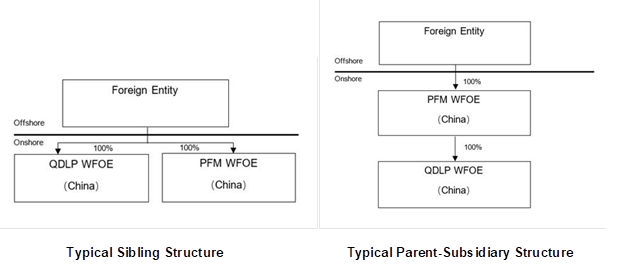
Additionally, if the QDLP and PFM managers are set up as parent and subsidiary companies rather than two sister companies, then (i) the role of the chief compliance officer can be subject to dual hatting arrangement between the PFM and the QDLP and (ii) the capital contributed for the purpose of establishing the QDLP manager will be counted towards the capital requirements of the PFM manager, resulting in a more flexible capitalisation structure. Please see the diagrams below for illustration.
Furthermore, Shanghai has very recently allowed using one same entity to apply for both PFM and QDLP status, to further streamline the process and bring down the establishment cost.
Fund Launch
Eligible investors of the programs
All PRC Private Fund Programs may be marketed to Qualified Investors2 (including Deemed Qualified Investors3). It is also possible to market QFLP products to offshore investors.
Direct fundraising vs third party distributor
Fundraising for funds established by private fund managers can be done either directly by the private fund manager, or by entrusting those who (i) are registered with the CSRC, (ii) have obtained the qualification of placement agent, and (iii) have become a member of the AMAC to raise private funds on behalf of the private fund manager (a Third Party Distributor).
Possibility to market WFOE PFM products to QFIIs and RQFIIs
According to current Qualified Foreign Institutional Investors (QFII) and Renminbi Qualified Foreign Institutional Investors (RQFII) regulations released by the CSRC, QFIIs/RQFIIs can only invest in "securities investment funds" which are retail funds. In other words, currently, QFIIs/RQFIIs are not allowed to invest in private securities investment funds offered by WFOE PFMs.
On 31 January 2019, the CSRC newly published two consultation papers, which propose to combine the QFII and RQFII schemes and to greatly expand their investment scope. In addition to stocks and bonds, QFIIs/RQFIIs would be allowed to purchase securities traded on China's main over-the-counter equity market (the New Third Board), derivatives (including financial futures, commodity futures and options) and private securities investment funds. This once officially issued will open a new horizon for PFMs to raise capital from foreign investors.
Read the latest updates on the QFII/RQFII reform:
Fund vehicle - contractual vs partnership/company
Under the PRC law, a private fund can take form of a partnership, a limited liability company or a fund management contract.
Partnerships and limited liability companies require establishment of legal entities and there is therefore a need to go through the business registration agency for any change of the investor/manager. They are commonly used for private equity related investment. A limited partnership agreement or articles of association will serve respectively as constitutional documents for a fund in form of a partnership or a limited liability company.
Contractual funds are all governed by contractual relationships between and among the investors, custodian and investment manager with no legal entity formed. Shares in such a contractual fund is notional and can be subscribed and redeemed by the investors. The constitutional document, i.e., fund contract will typically cover key issues such as the duties and rights of relevant parties, dealings, risk factors, investment strategies, service providers and etc.
Now the prevailing market practice in China is to use a contractual fund structure for PFM funds and QDLP funds, whilst using limited partnership for QFLP funds.
Fund product filing
A private fund manager shall file with the AMAC any private fund it raises within 20 business days after the fundraising is completed. The fund manager shall launch its first private fund within 6 months from the date of registration with the AMAC; otherwise, the AMAC may revoke the registration of the private fund manager. The 6-month timeline has now been extended to 12 months, partly due to the COVID-19 pandemic.
No substantial investment (other than cash management activities) can be done before a successful filing of the fund.
See more information on AMAC's notice on private fund filing:
Continuous obligations
Private fund managers are required to comply with a series of notification and reporting obligations as required by the AMAC, including regular reporting and extraordinary reporting.
In parallel to the reporting obligations to the AMAC, the QFLP/QDLP program also requires the manager to report major events to the local financial bureaux.
Depending on the area of investment, private funds may also need to comply with rules on market conduct, such as those against market manipulation and insider trading.
1The examinations are regularly held in Chinese but would be available in English upon request initiated by a sufficient number (e.g. no less than three) of PFM WFOE applicants. The applicants who make such a request shall concurrently meet the following conditions:
- They must declare that they will take a senior role in the PFM WFOE. Note that the chief compliance officer may only participate in the Chinese examination;
- They shall obtain the relevant qualifications for managing an overseas fund, or hold relevant qualification certificates such as Chartered Financial Analyst (CFA);
- They should have the relevant working experience in overseas asset management for more than five years;
- Additionally, the senior executives of the financial institutions in Hong Kong and Macao may also participate in the English examination. After passing the examination, they can apply for fund qualifications in accordance with the relevant provisions of the Mainland and Hong Kong Closer Economic Partnership Arrangement (CEPA).
2 “Qualified Investor” refers to an investor who:
- is capable of identifying and bearing relevant risks;
- invests at least RMB1 million in a private fund;
- is an entity with a net asset value of no less than RMB10 million; or
- is an individual with an average annual individual income of no less than RMB500,000 per year in the most recent three years or bank deposits, listed shares, bonds, fund units, asset management plans, bank wealth management products, trust products, insurance products and commodity futures of no less than RMB3 million.
3 “Deemed Qualified Investor” refers to any of the following:
- social security fund, corporate pension funds and other types of pension funds, charity funds, and other public welfare funds;
- investment plans that have been legally incorporated and filed with the AMAC;
- private fund managers and its personnel who have invested into the private funds managed by such private fund managers; and
- other investors as specified by the CSRC and the AMAC.