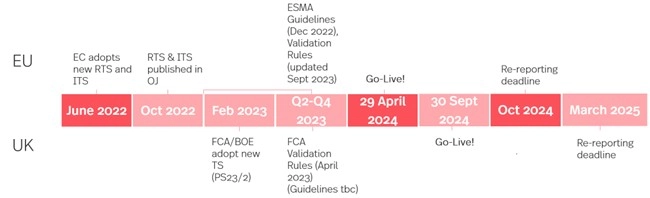
The new EMIR Refit reporting rules go live in the EU on 29 April 2024 and in the UK on 30 September 2024. Let’s recap what is and isn’t changing, and what buy-side firms could be doing now to prepare.
The reporting obligation
Counterparties established in the EU and the UK are required to report the details of any derivative contract entered into, and any modification or termination of the contract, to a registered or recognised trade repository (TR) on a T+1 basis. This obligation applies to over-the-counter (OTC) derivatives and exchange-traded derivatives (ETDs). A note regarding 'counterparties': the definition of financial counterparty (FC) under UK EMIR captures AIFs established in the UK (irrespective of the jurisdiction of their AIFM) and also captures third-country AIFs (e.g. Cayman Islands funds) with a UK authorised/registered AIFM. The same applies under EU EMIR, with references to the UK replaced by references to the EU.
The reporting obligation is predominantly two-sided, with both counterparties required to report and those two reports expected to match. One of the exceptions to this is known as 'mandatory reporting' - in 2019, EMIR Refit introduced changes which made an FC solely responsible, and legally liable, for reporting on behalf of both counterparties, the details of the OTC derivatives contracts (but not ETD contracts) concluded with a non-financial counterparty (NFC) that is below the clearing threshold (NFC-). An NFC- may choose to opt out of the mandatory delegated reporting regime. EMIR Refit also introduced an 'automatic delegation' of the reporting obligation to UCITS management companies in respect of OTC derivative transactions entered into by the relevant UCITS, and to AIFMs in respect of OTC derivative transactions entered into by the relevant AIFs. For more detail on this and other 2019 EMIR Refit changes, see our article "EMIR Refit: an overview".
In our experience, most, but not all, buy-side market participants who are in scope for the reporting obligation choose to appoint a delegated reporting agent (typically their broker counterparty) to make the reports on their behalf. These are known as 'voluntary delegated reporting' arrangements and they are typically papered with a written contract called a delegated reporting agreement (DRA). Unlike mandatory reporting, with voluntary delegated reporting arrangements the reporting entity (i.e. the delegator) remains responsible and legally liable for the reports. Some buy-side market participants, however, choose to self-report instead of entering into DRAs.
The new reporting rules do not change the existing position regarding responsibility for reporting. Rather, they dramatically alter the substance and form of the required reporting details.
Overview of the new reporting rules
Wholesale change
More than just an update - under both regimes the new reporting rules represent wholesale change requiring significant operational lift
More reporting fields - the number of fields increases from 129 to 203 in the EU and 204 in the UK (the UK has an additional, optional field, for execution agent), though we note not all fields will be applicable to all products or contracts
More specificity for notional amount reporting - the required method of computing notional amount is specified in the technical standards with regard to different types of products. Related new reporting fields for notional amount schedules, notional quantities and notional quantity schedules are included
More standardisation - reports to be based on ISO 20022 XML standards
Go-live dates
- 29 April 2024 in the EU and 30 September 2024 in the UK
- If you report under both EU & UK EMIR (noting it is not uncommon for UK investment managers to manage EU investment funds as well as UK or third-country investment funds), there will be a period of 5 months where you will have to report under the new reporting rules in the EU and the existing ones in the UK
Re-reporting obligation
Reports for outstanding derivatives must be updated by 26 October 2024 in the EU and 31 March 2025 in the UK
If modifications need to be reported during that transitional period, they should be reported under the new reporting rules
Misreporting notification obligation
EU EMIR
Scope
Any misreporting caused by flaws in the reporting systems that would affect a significant number of reports
Any reporting obstacle preventing the report submitting entity from sending reports to a TR within the deadline
Any significant issue resulting in reporting errors that would not cause rejection by a TR
Promptly notify, as soon as the entity responsible for reporting becomes aware of them
The notification shall indicate at least the type of the error or omission, the date of the occurrence, scope of the affected reports, reasons for the errors or omissions, steps taken to resolve the issue and the timeline for resolution of the issue and corrections
What is 'significant'? There is no one size fits all number but the ESMA Guidelines set out a detailed process which takes into account the number of reports made each month and the number of affected reports. This should be carefully reviewed
UK EMIR
Scope
- Any material errors or omissions in its reporting
Notify as soon as the entity responsible for reporting becomes aware of them
Other points to note
- Position level reporting only permitted where both counterparties agree
- Arrangements to be put into place to take into account TR feedback
Technical Standards, Guidelines, Validation Rules and other materials
EU EMIR
Technical standards: Commission Delegated Regulation (EU) 2022/1855 of 10 June 2022 (RTS) and Commission Delegated Regulation (EU) 2022/1860 of 10 June 2022 (ITS)
ESMA final report on Guidelines for reporting under EMIR (14 December 2022) (300+ pages; consultation paper also relevant)
Validation Rules - most recently updated 6 September 2023
UK EMIR
The Technical Standards (EMIR Reporting and Data Quality and Miscellaneous Amendments) Instrument 2023
Validation Rules published April 2023
No Guidelines published as at the time of writing
What should you be doing about the new reporting rules?
All counterparties that are responsible for reporting should familiarise themselves with the new reporting rules and consider what internal processes need to be established or modified in order to comply with the misreporting notification obligations. If counterparties wish to report at position level, this will need to be agreed by both counterparties. Any new or updated versions of the guidelines, validation rules and related materials published by the regulators should be monitored regularly.
For counterparties that self-report, a significant amount of work will be required to enhance existing systems and processes to take into account the new and modified fields and the hundreds of pages of interpretative guidance. Some firms may consider whether their existing reporting model remains fit for purpose based on the new requirements and the deviating regimes.
For counterparties that have put in place voluntary delegated reporting arrangements, we would expect that you are discussing the new reporting rules (including the re-reporting obligation) with your delegated reporting agent. They are likely to require additional information from you and you should also consider the provisions of your existing DRA. Bear in mind the misreporting notification obligations and give thought to how you will receive and assess the information needed to comply with them.
This will all require a significant amount of lead time, so our suggestion is that firms commence their planning earlier rather than later.
If you would like to discuss any aspect of the new reporting rules with us, please do get in touch.



.jpg?crop=300,495&format=webply&auto=webp)

.jpg?crop=300,495&format=webply&auto=webp)
.jpg?crop=300,495&format=webply&auto=webp)
.jpg?crop=300,495&format=webply&auto=webp)








.jpg?crop=300,495&format=webply&auto=webp)