



17 September 2026Publication
Data Dive: Navigating Data Centres
Welcome to our Data Dive podcast series, where we explore the world of Data Centres.
Below we summarise the UK's ground-breaking Online Safety Act, its key provisions and its practical implications for digital service providers.
The UK Online Safety Act (OSA) represents one of the most comprehensive attempts globally to regulate online platforms and improve digital safety for users, particularly children.
The OSA is regulated by Ofcom, the UK's existing communications regulator, with enforcement powers including penalties of up to £18 million or 10% of global turnover (whichever is higher). The OSA has been implemented in phases throughout 2025, with key obligations now in force.
The application of the OSA depends on the type of service provided and the level of risk associated with that service. The approach is fundamentally risk-based, with higher-risk services subject to more extensive obligations.
The Online Safety Act regulates three main categories of services:
Services deemed particularly high-risk due to their functionality or large user base will be designated as:
Certain services are exempt from OSA obligations, including:
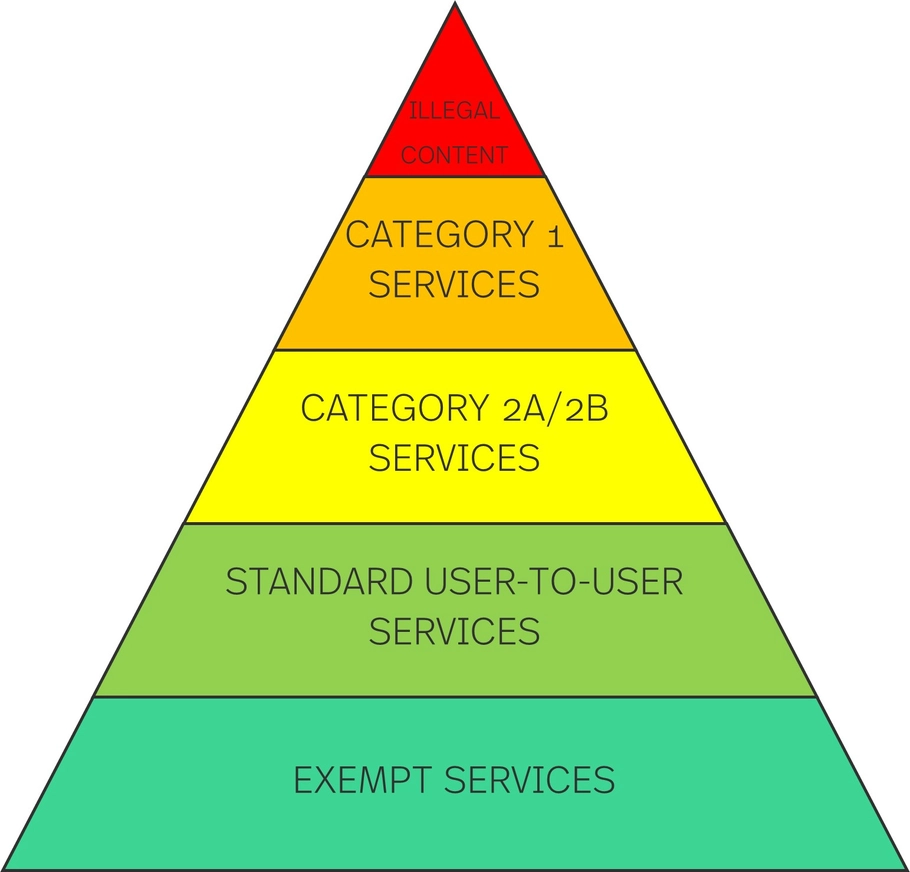
The Online Safety Act has significant extraterritorial reach, designed to protect UK users regardless of where the service provider is located. The Act applies to any provider of a user-to-user or search service that "has links" to the UK, meaning:
the service has a "significant number" of UK users; or
UK users form one of the target markets for the service.
International businesses must therefore assess whether their services fall within the OSA's scope and consider whether to implement UK-specific compliance measures or adopt OSA standards globally.
The OSA introduces comprehensive new duties that vary depending on the nature of the service and its risk categorisation:
Designated Category 1, 2A, and 2B services will face additional obligations including:
Ofcom is publishing codes of practice that are crucial for compliance. Whilst not mandatory, providers will be treated as complying with particular duties if they implement the measures described in the relevant Code of Practice. These codes provide practical guidance on meeting OSA obligations and are expected to be regularly updated to reflect technological developments.
The Online Safety Act represents a paradigm shift in digital regulation, imposing unprecedented duties on online service providers. Whilst the phased implementation provides time for preparation, the breadth and complexity of the obligations require immediate attention and strategic planning.
Success will depend on understanding the risk-based approach, implementing robust systems and processes, and maintaining ongoing compliance as the regulatory landscape evolves. Early preparation and proactive engagement with the regulatory framework will be essential for avoiding significant penalties and protecting both users and business interests.
The OSA's extraterritorial reach means that global platforms cannot ignore these obligations, regardless of their primary jurisdiction. The OSA sets a new international standard for online safety that is likely to influence digital regulation worldwide.
This document (and any information accessed through links in this document) is provided for information purposes only and does not constitute legal advice. Professional legal advice should be obtained before taking or refraining from any action as a result of the contents of this document.
If you have any questions, contact a member of the UK Online Safety Act team for assistance:
17 September 2026Publication
Welcome to our Data Dive podcast series, where we explore the world of Data Centres.
_11zon.jpg?width=380&width=380&format=webply&auto=webp "Article")
07 September 2026 Publication
Our updates are your trusted source for the latest news, expert analyses, and practical tips on navigating the complex landscape of data protection.

28 July 2026 Publication
The latest updates to the UK’s regulatory landscape for the autonomous vehicles industry.

22 June 2026 Publication
Our updates are your trusted source for the latest news, expert analyses, and practical tips on navigating the complex landscape of data protection

23 April 2026 Event
The evolving landscape of age assurance and age verification regulations across key jurisdictions